

Closing a funding round feels like crossing a finish line. In reality, you’ve just started a new race, one where equity administration becomes critical to your growth plans.
The fresh capital in your bank account triggers an immediate need to update how you value your common stock. Delaying this 409A valuation after a funding round creates growing costs that hit your hiring speed, compliance risk, and team morale harder than most founders expect.
The Hidden Bottleneck in Your Hiring Pipeline
Your Series A just closed. Three weeks later, your VP of Engineering wants to extend offers to two senior developers. There’s just one problem: you don’t have approved strike prices for their stock options.
This scenario plays out at startups every month. The culprit? A delayed 409A valuation update.
Understanding the Mechanism
When investors write checks for preferred shares, they’re buying securities with protective features: liquidation preferences, anti-dilution rights, and voting controls. These provisions don’t attach to common stock, which means the two share classes aren’t worth the same amount.
A 409A valuation calculates this gap. It tells you what common shares are worth today, which directly determines the exercise price for any stock options you grant.
Without this number, your equity compensation program grinds to a halt.
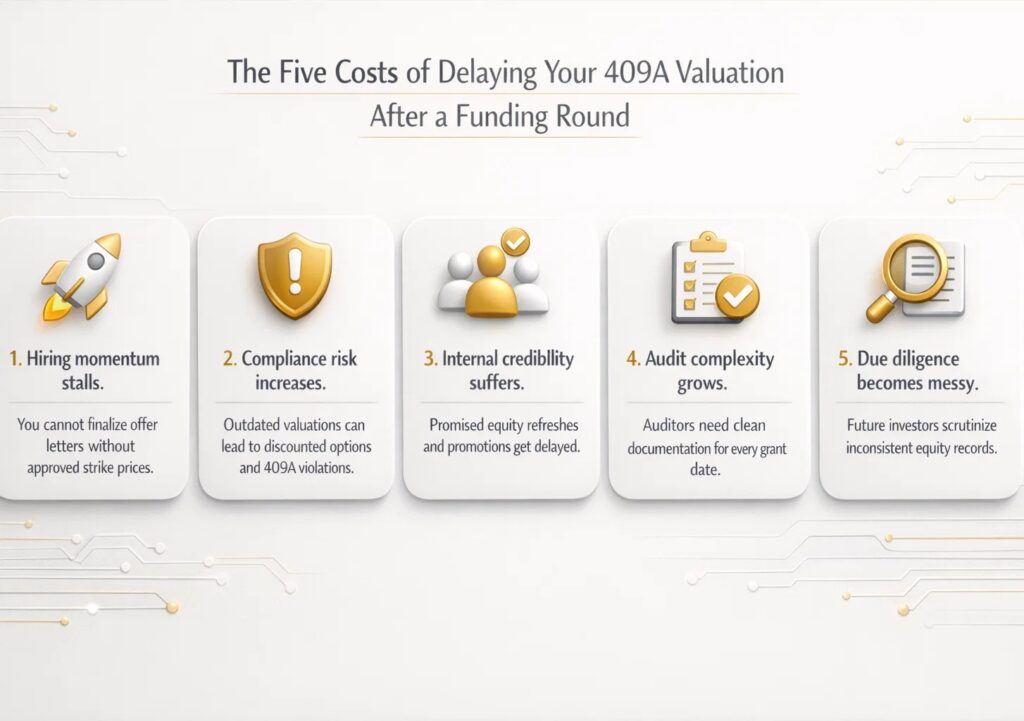
The Five Costs of Delaying Your 409A Valuation After a Funding Round
The expense of postponing your valuation update shows up across multiple parts of your business. These costs compound quickly and create problems that take months to resolve.
1. Hiring momentum stalls. You cannot finalize offer letters without approved strike prices.
2. Compliance risk increases. Outdated valuations can lead to discounted options and 409A violations.
3. Internal credibility suffers. Promised equity refreshes and promotions get delayed.
4. Audit complexity grows. Auditors need clean documentation for every grant date.
5. Due diligence becomes messy. Future investors scrutinize inconsistent equity records.
Each delay extends these problems. The following sections break down exactly how and when these costs appear.
How the Costs Appear Week by Week
Week One: Recruiting Friction
Your talent team can’t close offers. Candidates expect equity details during negotiations, not vague promises about “getting paperwork sorted out.”
Top performers rarely wait around. They accept competing offers with clearer compensation structures. The cost here is real: losing candidates you’ve spent weeks recruiting.
Week Three: Internal Tension
Your engineering manager promised promotion packages with equity refreshes. Now those grants are stuck in limbo, and the conversation with your team members gets uncomfortable. The cost is employee trust and retention risk.
Month Two: Accounting Headaches
Your auditors start preparing for the annual review. They need documentation showing how you determined the strike price for each option grant. Gaps in your valuation timeline create extra work and closer review. The cost appears as extended audit fees and finance team hours.
Month Four: Due Diligence Cleanup
A potential acquirer or your next round’s investors request your equity records. Inconsistent strike prices across similar grant dates raise questions. Your legal team now needs to draft explanatory memos instead of focusing on deal terms. The cost is to deal with momentum and trust with experienced investors.
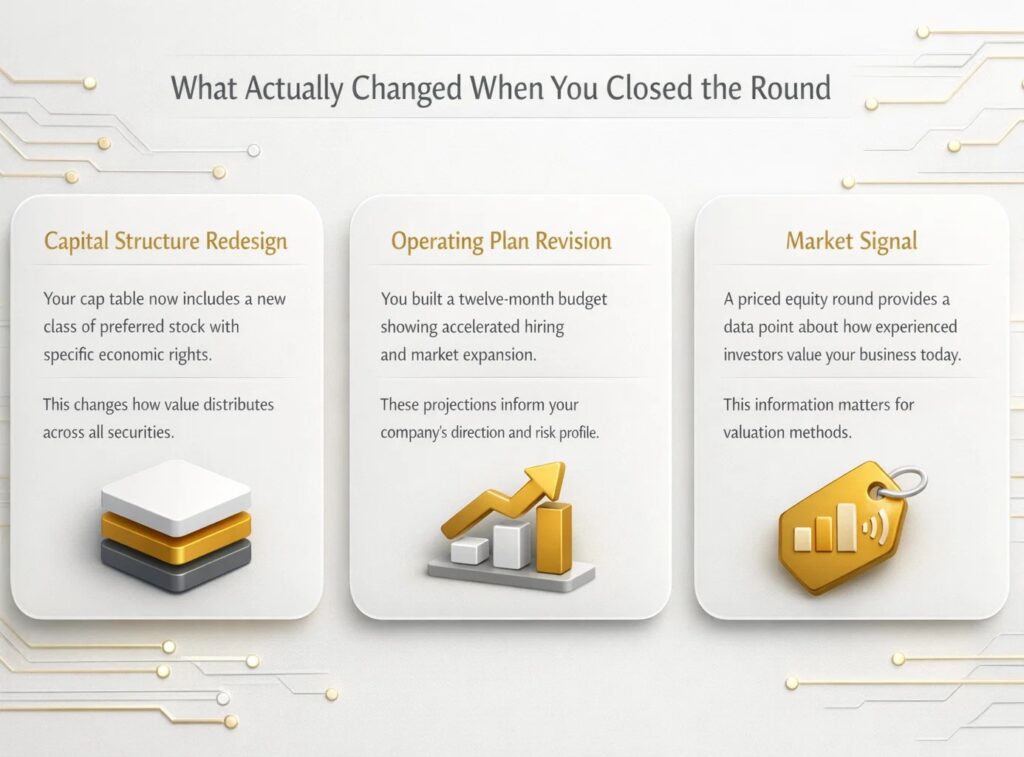
What Actually Changed When You Closed the Round
Consider three specific impacts:
Capital Structure Redesign
Your cap table now includes a new class of preferred stock with specific economic rights. This changes how value is distributed across all securities.
Operating Plan Revision
You built a twelve-month budget showing accelerated hiring and market expansion. These projections inform your company’s direction and risk profile.
Market Signal
A priced equity round provides a data point about how experienced investors value your business today. This information matters for valuation methods.
Each factor affects the calculation of the common stock fair market value. Ignoring them doesn’t make them disappear, it just postpones the needed update.
The Compliance Angle
Section 409A of the Internal Revenue Code imposes rules about deferred compensation. When stock options have an exercise price below fair market value at grant date, they trigger tax penalties for the recipient.
These aren’t company penalties. They hit the individual employee who received the discounted option.
Nobody wants to explain to a new hire that their equity package created an unexpected tax bill. The straightforward prevention: maintain current valuations and use them promptly.
Building Your Post-Close Workflow
Smart teams treat valuation updates as part of the closing checklist, not as an afterthought.
Immediate Actions (Days 1-5)
Finalize your cap table with all-around details: new money invested, shares issued, conversions executed, and updated option pool size. Designate one person as the source of truth.
Collect executed financing documents. Your valuation provider needs the actual terms: liquidation multiples, participation rights, conversion triggers, and any special provisions.
Week One Priorities
Update your financial model to reflect post-funding operations. Revenue projections, burn rate, hiring timeline, and key milestones should align with board-approved plans.
Schedule a board meeting or written consent process for the next option grant batch. Getting calendar holds now prevents scrambling later.
Documentation Package
Prepare a complete handoff to your valuation firm:
- Signed stock purchase agreement and certificate of incorporation amendments
- Final capitalization table showing all securities
- Board resolution approving the financing
- Updated twelve-month forecast with key assumptions
- Recent revenue performance and pipeline metrics
- Brief narrative explaining major changes since the last valuation
This preparation speeds up the analysis and reduces the number of question rounds.
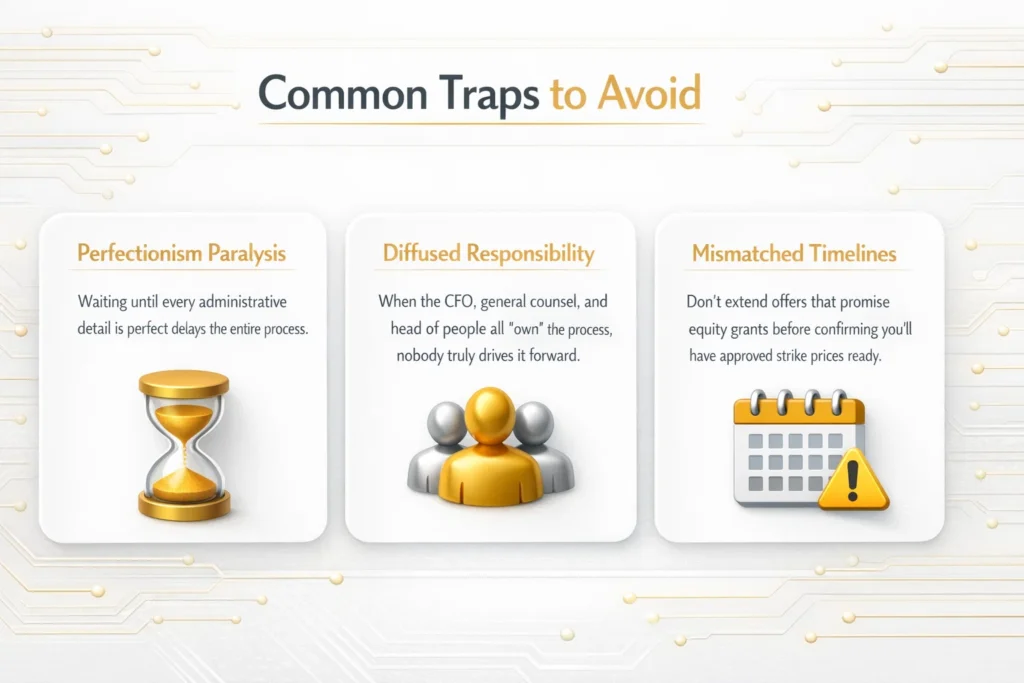
Common Traps to Avoid
Perfectionism Paralysis
Waiting until every administrative detail is perfect delays the entire process. Start when the economic substance is locked, even if paperwork finalization continues.
Diffused Responsibility
When the CFO, general counsel, and head of people all “own” the process, nobody truly drives it forward. Assign clear accountability.
Mismatched Timelines
Don’t extend offers that promise equity grants before confirming you’ll have approved strike prices ready. Synchronize recruiting and equity administration.
The Freshness Question
How long does a 409A valuation remain valid? There’s no bright-line rule, but most practitioners consider twelve months the outer limit for routine situations.
A priced financing round qualifies as material new information. It fundamentally alters your capital structure and business trajectory. Relying on a pre-money valuation after closing a significant round creates risk.
The practical approach: refresh your valuation immediately following any priced round.
The Business Case: Cost Avoidance Through Speed
Delays don’t just create compliance risk. They create opportunity cost that grows daily.
Your post-funding months are crucial for execution. New capital should speed up progress on hiring, product development, and revenue growth. Every week without the ability to grant equity is a week you’re not taking advantage of momentum. The cost of a delayed 409A valuation after a funding round far exceeds the few thousand dollars the valuation itself requires.
The fastest-moving companies treat their 409A update as closing-day infrastructure, just like updating banking relationships or filing charter amendments.
When to Kick Off the Process
The trigger is simple: begin your valuation update as soon as your financing documents are signed and your post-money cap table is settled.
Don’t Wait For Perfection
The perfect forecast
- Directionally accurate is sufficient.
Every board member to review draft minutes
- You need resolutions, not perfection.
Hiring to actually start
- It’ll happen faster than you expect.
An early start creates buffer room. Buffer room prevents compressed timelines and rushed decisions.
Questions Founders Actually Ask
“We’re not hiring for another month. Can we wait?”
Maybe, but probably not. Grant needs appear suddenly: a key promotion, an unexpected strong candidate, or a retention situation. Having a current valuation ready prevents scrambling.
“Can’t we just use the preferred price?”
The preferred share price reflects preferred terms. Common stock lacks those protections, so it’s worth less. Using the wrong number creates 409A problems.
“What if we already granted some options right after closing?”
Review those grants with your legal counsel. If strike prices were set below current fair market value, you may need corrective action and employee communication.
“How much does this cost compared to the delay risk?”
A 409A valuation typically costs a few thousand dollars. The cost of delayed hiring, audit complications, and compliance exposure runs much higher. The math favors proactive updates.
Take Action Now
Your funding round changed your company’s financial reality. Your common stock valuation needs to reflect that reality before you grant your next option.
The cost of delaying your 409A valuation after a funding round shows up as lost candidates, frustrated employees, complicated audits, and messy due diligence. Each problem is preventable with proper timing.
The companies that execute best on post-funding growth are the ones that treat equity administration as strategic infrastructure, not back-office paperwork.
Start your 409A update with Bookman Capital the week you close. Your recruiting team, your employees, and your auditors will thank you. Contact Bookman Capital Today!
Sources: