

Imagine building a thriving business over ten years, only to discover it’s worth 40% less than expected. The culprit? Three clients generate 75% of your revenue.
This scenario plays out daily in valuation meetings across the country. Buyers don’t reject these businesses outright, but they slash valuations or restructure deals to protect themselves from the risk.
Customer concentration risk is a silent valuation killer that most owners discover too late. Whether you’re planning an exit or simply want to understand your company’s true worth, grasping how revenue concentration affects business valuation is critical.
Let’s break down what smart buyers see when they examine your client roster.
What is Customer Concentration?
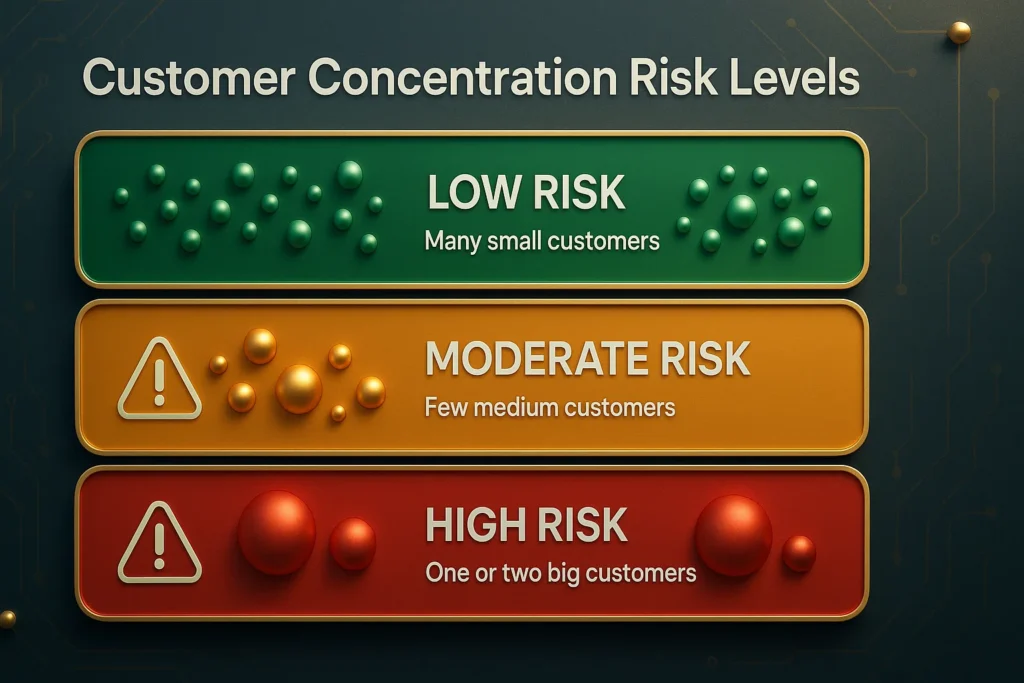
Customer concentration happens when too much of your money comes from too few clients. If one customer accounts for 10% or more of your revenue, you’re entering territory that makes investors nervous.
The math is straightforward. Take what your biggest client pays you annually. Divide that by your total revenue. Multiply by 100.
Here’s what this looks like in practice. Your business brings in $5 million a year. Your largest client pays you $1.75 million. That’s 35% customer concentration.
Why does this matter? Because losing one major customer could wipe out a third of your cash flow overnight. Buyers factor this vulnerability directly into their offers.
Calculating your customer concentration takes about five minutes. Start with your biggest customer. Their annual payments divided by your total revenue gives you the percentage.
Next, look at your top three clients combined. Many buyers start to worry once this exceeds 40% to 50%, though the threshold varies by industry and contract quality.
Finally, check your top ten clients as a percentage of revenue. This shows the overall health of your customer base.
| Test Type | How to Calculate | General Guideline | Priority Level |
| Top Client % | Top Client Revenue ÷ Total Revenue × 100 | Watch above 15-20% | High |
| Top 3 Clients % | Top 3 Revenue ÷ Total Revenue × 100 | Caution above 40-50% | Medium |
| Top 10 Clients % | Top 10 Revenue ÷ Total Revenue × 100 | Monitor above 60-70% | Lower |
These thresholds serve as general guidelines, not absolute rules. Contract terms, relationship depth, and industry norms all influence how buyers evaluate your specific situation.
How Concentration Affects Your Valuation
Buyers adjust their offers when they spot customer concentration. The adjustments vary based on multiple factors beyond just percentages.
A well-diversified business might sell for 5x to 6x EBITDA. That same business with 35% customer concentration and weak contracts? It might drop to 3x EBITDA.
With strong multi-year contracts and deep institutional relationships? Perhaps 4x to 4.5x EBITDA.
Let’s use real numbers. Your company generates $1 million in EBITDA annually. At a 5.5x multiple, you walk away with $5.5 million. At 3x, just $3 million.
The difference between strong and weak customer concentration structures can mean $1 million to $2.5 million in exit value.
Data from middle market transactions shows patterns. Businesses with a single customer above 25% of revenue typically face valuation adjustments of 20% to 40%.
However, a business with multi-year contracts, automatic renewals, and 180-day termination clauses faces smaller discounts than one with month-to-month agreements.
The discount varies significantly by industry. Enterprise software companies with sticky products can operate safely with a higher concentration than professional services firms built on personal relationships.
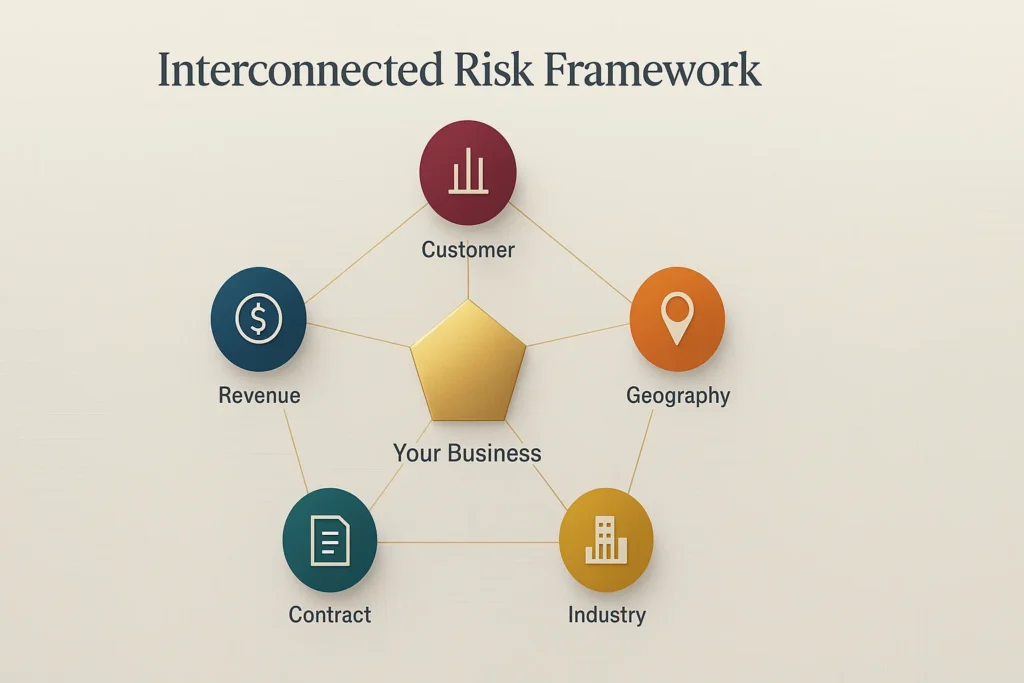
Customer concentration represents one of several risk factors buyers examine. They also evaluate team dependence, industry diversification, geographic spread, and revenue type.
The Type of Revenue Changes Everything
Revenue concentration risk varies dramatically based on whether your revenue is recurring or project-based. This distinction often matters more than the concentration percentage itself.
Recurring revenue with strong contracts significantly offsets customer concentration concerns. A SaaS business where 30% of revenue comes from one client on a three-year contract with automatic renewal faces moderate risk.
Project-based revenue magnifies concentration risk substantially. A consulting firm where 30% of revenue comes from annual projects that must be re-won creates severe vulnerability.
Buyers evaluate these scenarios completely differently. They might apply a 15% to 20% discount for the SaaS business but a 40% to 50% discount for the project-based firm, even at identical concentration levels.
The Hidden Risks Beyond the Obvious
Customer count only tells part of the story. Smart buyers dig deeper to find risks that basic calculations miss.
Geographic concentration creates risk even with 50 different customers. All your clients in one state face the same economic pressures. A regional recession hits everyone simultaneously.
Industry concentration works similarly. Serving 30 restaurants sounds diversified until economic shocks hit the entire sector at once. Your customer count was high but your actual risk stayed concentrated.
Buyers look for common factors that could trigger correlated customer losses. They want diversity across geography, industry, customer size, and business model.
Contract quality matters enormously. Month-to-month agreements signal maximum risk. Multi-year contracts with automatic renewals provide stability that buyers value highly.
Termination notice periods significantly influence valuation. 30-day clauses are weak. 90-day clauses are better. 180-day clauses with financial penalties for early termination substantially reduce buyer concerns.
Your Path to Better Diversification
Reducing customer concentration takes strategic effort over 12 to 24 months. Start your diversification plan at least two years before your target exit.
Here’s your action plan:
1. Audit your current situation comprehensively. Calculate concentration percentages. Map customers by industry, geography, and contract type. Review your contract portfolio for termination clauses and renewal terms.
2. Set realistic 12 and 24-month targets. General guidelines suggest keeping single clients under 15% to 20% and the top five under 40% to 50%, but adjust based on your industry norms and contract quality.
3. Identify markets where you can grow profitably. Focus on industries, regions, and customer types where you have competitive advantages.
4. Build systematic lead generation. Create marketing that produces predictable results. Make new customer acquisition repeatable, not random.
5. Strengthen existing customer contracts. Negotiate longer terms, automatic renewals, and stronger termination protections. Build relationships across multiple contacts in each organization.
6. Expand service offerings to existing clients. Cross-selling reduces concentration risk. A client buying multiple services is both more valuable and less likely to leave.
7. Track progress monthly. Monitor concentration trends, new customer rates, and contract improvements.
What Buyers Want to See
Declining concentration trends over two to three years show that you actively manage this risk. Strong contracts with multi-year terms, automatic renewals, and meaningful termination protections dramatically reduce concerns.
Institutional relationships spanning multiple contacts matter. Single-person relationships create risk even with good contracts. Show that several team members work with each important client.
Document your sales process, conversion rates, and pipeline. Buyers need confidence that you can replace any departing customer.
Show documented processes, account management systems, and team capabilities. Buyers discount businesses dependent on founder relationships.
The Million Dollar Difference
Two businesses generate identical revenue and profit. Yet one sells for $5.5 million while the other gets $3 million. Customer concentration explains much of this gap.
Company A built a diversified customer base with strong contracts. No single client exceeds 8% of revenue. The top five represent 32% of sales. Multi-year contracts with automatic renewals protect relationships.
The winning offer comes in at 5.5x EBITDA, valuing the business at $5.5 million.
Company B’s largest client provides 35% of revenue on annual renewals. The top five control 68% of the business. Weaker contract terms and concentration concerns limit buyer interest.
The final offer comes in at 3.0x EBITDA, valuing the business at $3 million.
These businesses are otherwise identical. Only the customer structure and contract quality differ. That combination creates a $2.5 million valuation gap.
Your Questions Answered
What is customer concentration in simple terms?
Customer concentration means too much revenue comes from too few customers. Many buyers start to worry when a single customer exceeds 15% to 20% of revenue, though industry norms and contract quality influence this threshold. Customer concentration creates risk because losing one major customer could significantly hurt your business and cash flow.
How much does customer concentration lower my business value?
Customer concentration typically reduces valuations by 20% to 50%, but the impact depends heavily on contract terms and industry context. A business with one client at 30% of revenue on multi-year contracts might see a 20% to 25% discount. The same concentration with month-to-month agreements could face 40% to 50% reductions. For more on how specific metrics affect your valuation, read our guide on what investors look for in SaaS valuation.
How long does it take to fix customer concentration before selling?
Expect 12 to 24 months to meaningfully improve your situation. Real diversification takes strategic customer acquisition, relationship building, and contract improvements. If you’re planning an exit, start addressing concentration at least two years before going to market. Buyers examine three to five years of history and value positive trends.
Start Building Value Today
Don’t let addressable concentration issues cost you millions at exit. Bookman Capital specializes in helping business owners maximize valuation by identifying and addressing concentration risks before they go to market.
Schedule a confidential valuation consultation today. Visit Bookman Capital at https://bookmancapital.io to get started.
Sources: