
Your prospect just asked about your data privacy practices. What happens next decides whether you close the deal or watch it die.
When these buyers evaluate your platform, their legal and security teams are asking one loaded question: “If something goes wrong, will you protect us?” SaaS buyers now reject vendors who fumble data privacy questions. Companies that answer privacy concerns fast and clearly close deals faster than competitors who hesitate.
The next five strategies show you exactly how to build that proof and make data privacy your most compelling competitive edge. Data privacy isn’t a checkbox anymore. It’s a sales weapon.
Why Data Privacy Strategy Determines SaaS Revenue
Data breaches cost companies an average of $4.45 million in 2023, according to IBM Security. That number climbs to $9.48 million for healthcare organizations. Buyers know these statistics. They’re terrified of becoming the next headline.
SaaS companies face a brutal reality. One privacy incident erases years of reputation building. The fallout extends beyond immediate costs. Customer churn accelerates. New sales pipeline dries up. Investors pull back.
Smart SaaS founders flip this threat into a competitive advantage. They build privacy into their sales process from day one. Companies with documented privacy programs and certifications consistently outperform competitors in enterprise sales cycles.
The Modern Buyer Expects Privacy Proof
Enterprise procurement teams now include security analysts in vendor reviews. These analysts ask detailed questions about encryption, access controls, and incident response. Generic answers kill deals instantly.
B2B buyers want specifics. They request SOC 2 reports, penetration test results, and data processing agreements before conversations progress. Companies that provide these documents immediately gain trust. Those who scramble to produce them look unprepared.
The shift reflects regulatory pressure too. GDPR fines reached €5.88bn through 2024. US states passed 7 new privacy laws in 2024 alone, bringing the total to 20 states with comprehensive privacy legislation. Buyers face personal liability if they choose non-compliant vendors. Your privacy strategy protects their careers.
Strategy 1: Get Your Compliance Certifications Early
SOC 2 Type II certification takes 6 to 12 months to complete. Many SaaS founders wait until prospects demand it. Wrong move. Start your audit when you hit $500k ARR or land your first enterprise prospect.
The certification process forces you to document security controls. You’ll implement logging, access reviews, and change management procedures. These systems prevent breaches and build operational maturity.
Key Certifications by Market:
| Market Segment | Required Certifications | Average Time to Complete |
| Enterprise B2B | SOC 2 Type II, ISO 27001 | 8 to 14 months |
| Healthcare | HIPAA, SOC 2, HITRUST | 12 to 18 months |
| Financial Services | SOC 2, PCI DSS, ISO 27001 | 10 to 16 months |
| Government | FedRAMP, StateRAMP | 18 to 36 months |
Budget $90k to $150k for your first SOC 2 compliance program. The investment pays back fast. Companies report shorter sales cycles after achieving certification.
The Certification Timeline Reality
Start with a readiness assessment. Security firms charge $5k to $15k to identify gaps in your controls. Fix these gaps over 3 to 6 months. Then begin the formal audit period.
The audit itself runs 3 to 6 months. Auditors test your controls and review documentation. They interview staff and examine system configurations. Any failures require remediation and retesting.
Plan for the maintenance burden. SOC 2 requires annual renewals. You’ll need dedicated staff or consultants to maintain controls and prepare evidence. But enterprise buyers won’t consider vendors without current reports.
Strategy 2: Make Data Processing Transparent
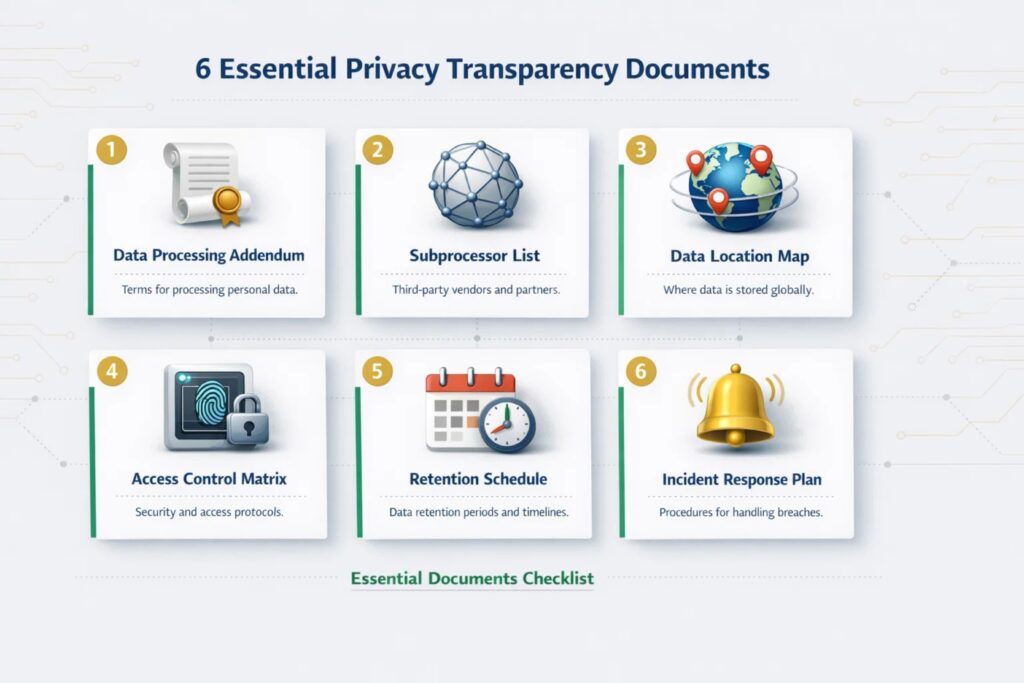
Buyers want to know exactly what happens to their data. Where does it live? Who can access it? How long do you keep it? Answer these questions before prospects ask.
Create a data flow diagram that shows each processing step. Mark the geographic locations of every server and database. Note which employees and contractors have access. Document retention periods for each data type.
This transparency builds trust immediately. Prospects see that you understand their concerns. They recognize you’ve thought through the details. Most competitors still provide vague answers about “industry standard security.”
The documentation seems heavy. But prospects request these items anyway during security reviews. Preparing them early accelerates every deal.
Building Your Data Inventory
Map every data element you collect, process, or store. Categorize by sensitivity level: public, internal, confidential, restricted. Identify the legal basis for processing under GDPR and other privacy laws.
Document data sources and destinations. Track integrations with third-party services. Many SaaS companies discover they share data with 15 to 30 vendors. Each vendor becomes a risk point that prospects evaluate.
Update your inventory quarterly. New features introduce new data flows. Forgotten integrations create compliance gaps. The inventory keeps your team aligned on privacy obligations.
Strategy 3: Design Customer-Controlled Privacy Features
Give customers direct control over their data. Let them export everything in standard formats. Provide self-service deletion tools. Show them the access logs for their account.
These features differentiate your product in competitive evaluations. Buyers compare vendor capabilities side by side. The company offering better privacy controls wins.
Stripe exemplifies this approach. Their dashboard shows customers every API call, every data access, and every integration. Customers can revoke access instantly. This transparency contributed to Stripe’s growth to a $91.5bn valuation.
High Impact Data Privacy Features:
- One-click data export in JSON, CSV, and PDF formats
- Granular permission controls for team member access
- Real-time access logs with user, timestamp, and action
- Automated data retention with configurable periods
- Self-service account and data deletion
- Encryption key management for enterprise customers
Build these features into your product roadmap early. Adding them later requires significant refactoring. The upfront investment saves money and accelerates enterprise adoption.
The Privacy Dashboard Approach
Create a dedicated section in your application for privacy controls. Salesforce calls theirs Privacy Center. HubSpot labels it Privacy & Consent. The exact name matters less than visibility.
Surface key information prominently. Show what data you’ve collected. Display active integrations. List recent access events. Make actions obvious with clear buttons and workflows.
Test the dashboard with actual customers. Watch where they click. Note the questions they ask. Refine based on real usage patterns. Data privacy dashboard only helps if customers actually use it.
Strategy 4: Speed Up Security Questionnaire Responses
Enterprise buyers send security questionnaires with 200 to 500 questions. Sales teams often take 3 to 6 weeks to complete these documents. That delay stalls deals and frustrates buyers.
Standardize your answers. Build a master response document covering common questions. Include supporting evidence like audit reports and policies. Update the document quarterly as your security posture evolves.
Tools like SafeBase and Conveyal automate this process. They host your security documentation in a customer facing portal. Prospects get instant answers. Your team saves 40 to 60 hours per deal.
Companies using these platforms report accelerated enterprise sales cycles. The time savings compounds across your entire sales pipeline. Each deal that moves faster creates capacity for more deals.
Building Your Security Response Library
Extract questions from the last 10 security questionnaires you completed. You’ll notice 70% to 80% overlap across buyers. These repeated questions become your core library.
Write detailed answers with specific evidence. Don’t say “we encrypt data.” Say “we use AES 256 encryption for data at rest and TLS 1.3 for data in transit.” Include policy references and control descriptions.
Assign owners to each answer. Security team owns technical controls. Legal owns contractual terms. Engineering owns architecture questions. Clear ownership ensures accurate, current responses.
Strategy 5: Train Sales Teams on Privacy Language
Your sales team needs privacy fluency. Prospects ask technical questions during discovery calls. Fumbled answers create doubt. Confident, accurate responses build credibility.
Run monthly training sessions covering new regulations, product updates, and competitive positioning. Role play common objection scenarios. Review lost deals where data privacy concerns drove the decision.
Create reference cards for common questions. List key statistics, certification dates, and feature capabilities. Sales reps access these cards during live calls. The quick reference prevents errors and builds confidence.
Essential Sales Training Topics:
- Current compliance certifications and renewal dates
- Data residency options and geographic restrictions
- Encryption standards for rest and transit
- Access control capabilities and audit logging
- Incident response procedures and SLA commitments
- Customer privacy feature demonstrations
- Competitive data privacy positioning and differentiation
Track which questions come up most often. Refine your training based on actual sales interactions. The feedback loop improves both training content and product positioning.
The Privacy Champion Model
Designate one sales team member as privacy champion. This person becomes the internal expert. They join complex deals and handle technical objections. Other reps escalate difficult questions to them.
The champion stays current on regulations and certifications. They maintain relationships with your security and legal teams. They translate technical concepts into business value for prospects.
Rotate the champion role annually. This spreads expertise across your team. It prevents knowledge silos. Multiple team members gain deep privacy fluency over time.
Measuring Data Privacy Strategy Impact on Revenue
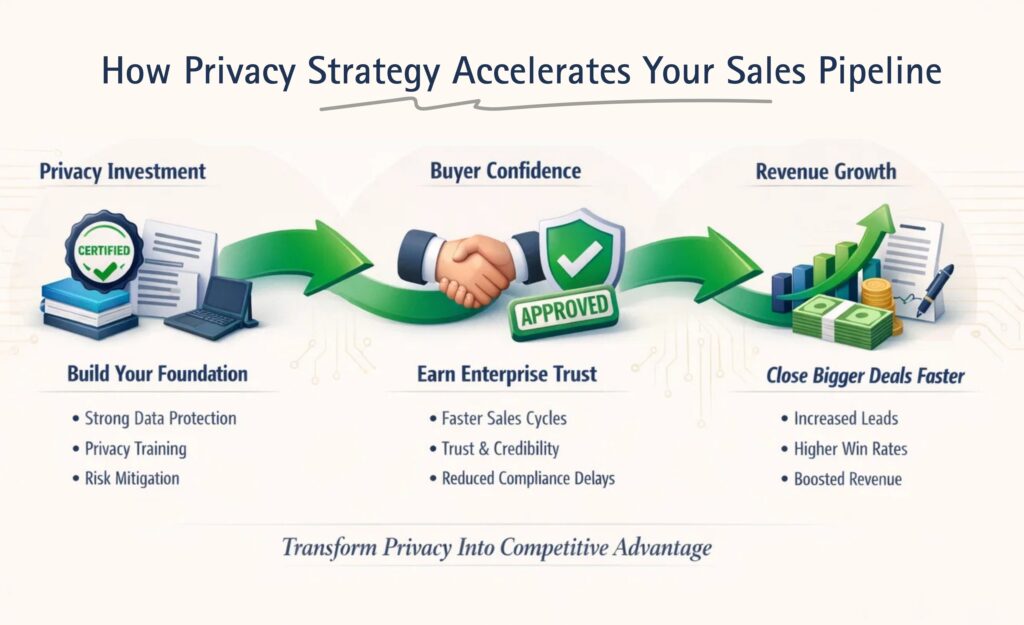
Track specific metrics to prove your privacy investment drives results. Win rate tells part of the story. Companies with strong privacy programs and current certifications consistently win more enterprise opportunities than competitors without formal programs.
Sales cycle length matters too. Measure time from the first meeting to the contract signature. Privacy-prepared companies typically close deals faster because they can immediately provide the documentation buyers need.
Deal size often increases with privacy maturity. Enterprise buyers pay premium prices for vendors who reduce their compliance risk. The pricing power offsets certification and tooling costs.
Monitor security questionnaire completion time. Track days from receipt to submission. Faster responses correlate directly with higher close rates. Each delay in providing security documentation extends the sales cycle and risks losing buyer momentum.
Creating Your Privacy ROI Dashboard
Build a simple dashboard tracking 5 metrics: win rate by deal size, average sales cycle, security review duration, privacy feature adoption, and compliance cost per customer.
Compare quarters year over year. Look for improvement trends as you implement these strategies. Share results with the executive team and the board. The data justifies continued privacy investment.
Survey lost opportunities. Ask prospects which vendors they chose and why. Privacy concerns frequently appear as deciding factors in enterprise losses. Address the specific gaps prospects identified.
Moving Forward With Privacy as Sales Advantage
Data privacy strategy stops being a cost center when you tie it to revenue metrics. The companies winning enterprise SaaS deals treat privacy as a product differentiator and a competitive moat.
Start with certification. Get your SOC 2 process moving this quarter. Build transparency documents while you wait for audit completion. Design customer-facing privacy controls into your next product sprint.
Your sales team needs these tools to compete. Enterprise buyers demand privacy proof before they’ll consider your solution. The preparation work takes 6 to 12 months. But the payoff lasts for years.
SaaS companies that build privacy into their DNA from the start grow faster and command higher valuations. They avoid costly breaches. They close bigger deals. They sleep better at night.
Ready to build a privacy program that accelerates your SaaS growth?
Our team at Bookman Capital works with software companies to structure compliance strategies that drive revenue. We understand how data privacy investments translate to enterprise sales success and can help you build the right program for your growth stage. Get started by connecting with Bookman Capital today.
Sources:
- 1. IBM Security and Ponemon Institute. (2023). *Cost of a Data Breach Report 2023*
- 2. DLA Piper. (2025). *GDPR Fines and Data Breach Survey: January 2025*
- 3. Wilson Sonsini Goodrich & Rosati. (2024). *Seven New States Join Patchwork of U.S. Comprehensive Privacy Laws*
- 4. Multiple sources including Bloomberg, TechCrunch, Fortune. (February 2025). *Stripe Valuation Reports*