
You know what’s worse than losing a deal? Closing one and watching it fall apart.
Imagine buying a SaaS company with stellar metrics. Everything checks out. Revenue is climbing. Customers seem happy. Then two months in, you notice something alarming. Support tickets are piling up. Renewal rates are dropping. By day 90, a quarter of your customers have left.
This happens more often than anyone wants to admit. The culprit isn’t the product or the price. It’s how the SaaS transition gets handled. When customers sense uncertainty, they start looking for alternatives. The fix is simpler than you think, but it requires doing five things right from the start.
Companies that nail these steps keep retention above 85%. Those that don’t can lose up to 30% of their customer base. The difference isn’t luck. It’s preparation.
The Retention Crisis Nobody Talks About
Your SaaS business runs on recurring revenue. When ownership changes, every customer relationship becomes vulnerable. Most fail not because of bad products but because nobody thought about the customer experience during the handoff.
What the Numbers Actually Reveal
Poor planning leads to churn rates between 15% and 30%. That’s not just losing customers. That’s watching your valuation crumble. Right now, private SaaS companies with solid retention get valued around 4.8 times their annual revenue. If retention tanks during a transition, so does that multiple.
Companies that take transitions seriously keep churn under 6%. The difference comes down to having a real plan and sticking to it. Studies show that 60% of acquisitions fail to meet expectations, mostly because communication breaks down.
What Keeps Customers Up at Night
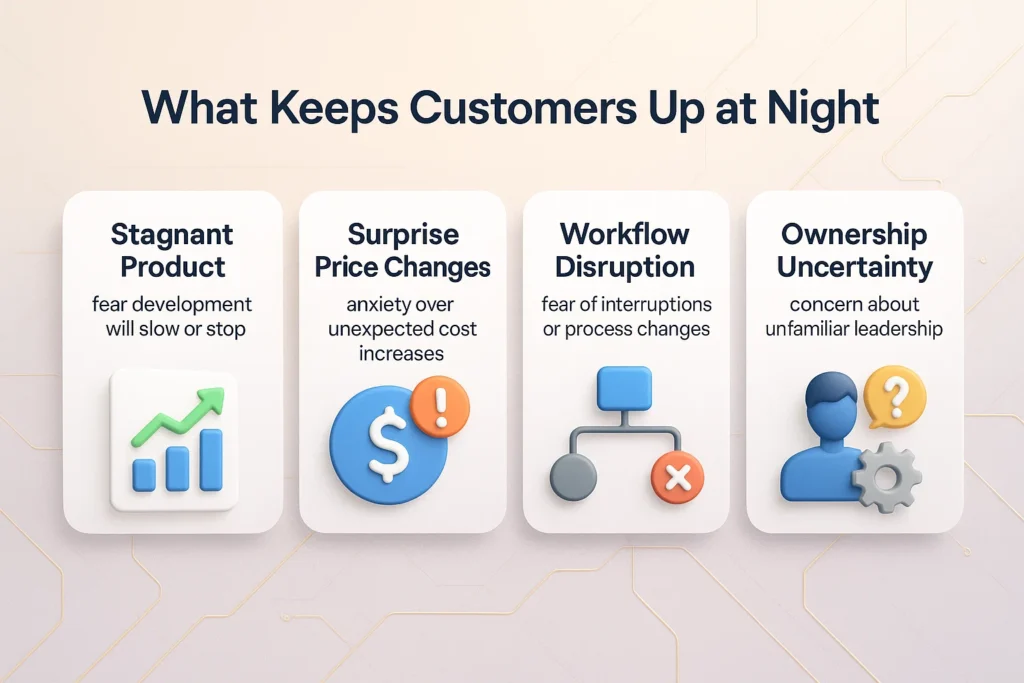
Think about what customers are actually worried about. They wonder if the product they rely on will stop improving. They’re nervous about surprise price increases. They fear their workflows will get disrupted. These aren’t irrational concerns.
| Phase | Timeline | What Matters Most | Success Looks Like |
| Pre-Close | 30 days out | Getting documents ready, aligning teams | Everything organized and ready |
| Announcement | First 3 days | Reaching every customer, answering questions | Less than 2% immediate churn |
| Early Days | Days 4 to 30 | Building relationships, shipping quick wins | Churn stays below 5% |
| Settling In | Days 31 to 60 | Improving product, refining processes | Support metrics stay stable |
| Full Speed | Days 61 to 90 | Launching features, finding growth opportunities | Revenue retention above 100% |
Step One: Control the Narrative from Day One
The biggest mistake? Waiting too long to tell customers what’s happening. They’ll find out anyway. You want them hearing it from you first, not from a press release or LinkedIn rumor.
Build Your Communication Timeline Early
Start planning your announcement at least a month before closing. Figure out who needs to hear what. Your biggest customers need different messages than someone on a basic plan. Long-time users need more reassurance than people who just signed up last month.
Companies that communicate early and clearly get better outcomes, including stronger retention that protects valuation. Buyers pay more for businesses that know how to keep customers through the transition.
Focus on What Stays the Same
Your message should emphasize continuity. The product they love isn’t changing. The support team they know isn’t going anywhere. The features they’ve been waiting for are still coming. Then you can talk about the good stuff, like more resources for development or new capabilities you couldn’t afford before.
Send your first message within 48 hours of closing. Follow up with detailed answers to common questions. Then get on calls with your top revenue customers within the first week. No mass emails for these relationships.
Make Every Message Personal
Sending the same generic email to everyone destroys trust. Break your list into segments based on company size, industry, and how actively they use your product. Each group gets messaging that speaks to their specific situation.
Step Two: Turn Tribal Knowledge into Documentation
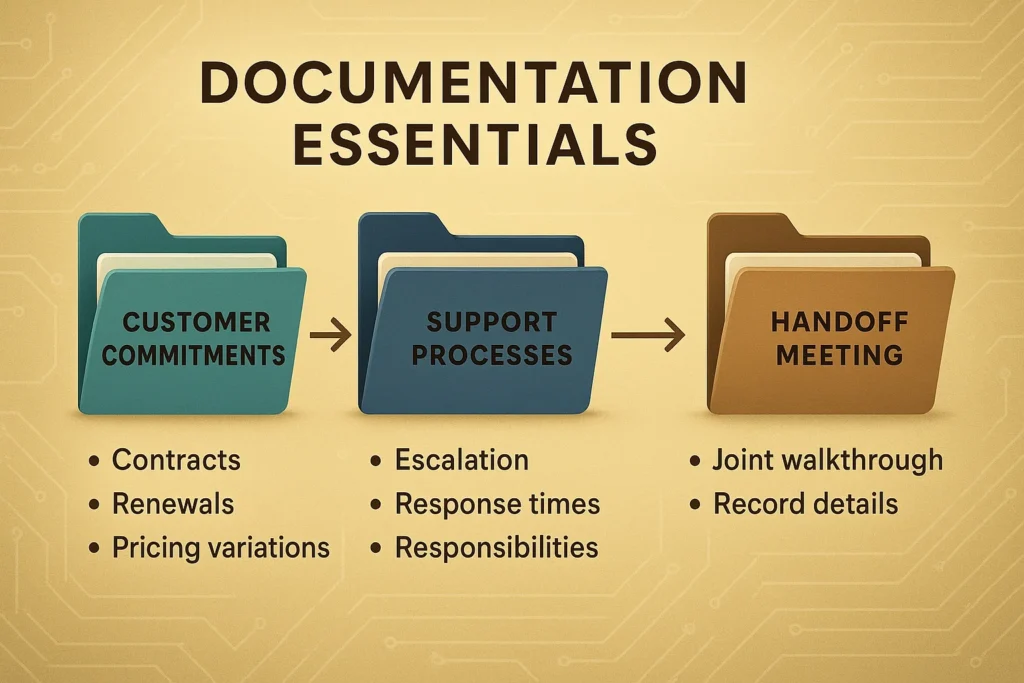
Knowledge trapped in someone’s head is useless during a SaaS transition. The handoff exposes every gap in your documentation. Buyers need the full picture on customer contracts, product capabilities, and how support actually works.
Capture Every Customer Promise
Start with contracts and commitments. Every promise ever made to a customer needs to be written down and honored. Missing these details leads to disappointed customers and quick cancellations. Include renewal dates, custom features, and any special pricing deals.
Top SaaS companies hit retention rates between 72% and 88%. They excel at documentation because they know that 60% of SaaS deals include earnout periods tied directly to keeping customers happy.
Map Your Support Processes
Support processes need equal attention. How does escalation work? What are your response time commitments? Who handles what types of problems? New owners need this information to keep service quality consistent.
The Critical Handoff Meeting
Schedule the handoff meeting within your first week. Get both teams in the room. Walk through every process, relationship, and technical detail. Record the whole thing. You’ll need to reference it later when questions come up.
Step Three: Prove Development Momentum is Real
Nothing kills customer confidence faster than a product that stops improving. Customers watch for signs that development has slowed down. Keeping visible momentum proves you’re still invested in making the platform better.
Ship What You Promised
Don’t delay feature releases because of the transition. If something was on the roadmap, ship it. Every delay signals to customers that their needs aren’t the priority anymore. That’s when they start evaluating competitors.
Companies with strong margins above 80% get valued around 7.6 times revenue. Drop below that and valuations fall to 5.5 times. Maintaining them during a transition proves the fundamentals are solid.
Keep Quality from Slipping
Quality can’t slip during transitions either. Actually, you need to watch it more carefully than usual. Monitor system performance closely. Fix issues faster than normal. Show through actions that service is getting better, not worse.
Consistent product quality during transitions can significantly reduce churn. Customers stick with platforms that keep evolving. They leave products that seem to stagnate.
Protect Your Engineering Team
Keep your core engineering team intact through the transition. Their knowledge prevents quality from degrading. Their presence reassures customers about technical continuity. Losing key developers during a transition sends exactly the wrong signal.
Step Four: Turn Your Top Customers into Champions
Your top 20% of customers probably generate 60% or more of your revenue. You can’t handle these relationships with automated emails during a SaaS transition.
Give Enterprise Clients Personal Attention
Big customers expect personal attention when ownership changes. Get on video calls with decision makers at your major accounts. Listen to what worries them without getting defensive. Share your vision and how it benefits their specific needs.
Create success plans for each major customer within 30 days. Write down their goals, how they use your product, and where they could expand. This investment pays off through maintained revenue and growth opportunities.
Scale Smart Across Your Customer Base
Getting new customers costs five to seven times more than keeping existing ones. Companies with churn below 6% get premium valuations. Every percentage point of improvement directly impacts what your business is worth.
Scale your relationship building through smart segmentation. Top customers get high-touch personal outreach. Mid-tier accounts get personalized communication with clear paths to escalate issues. Smaller customers get excellent automated messages with easy access to support.
Build Community During the Chaos
Create spaces where customers connect with each other and share tips. Launch advisory boards that give key accounts real influence over product direction. These programs build loyalty beyond just the features.
Companies with Net Revenue Retention above 120% get valued at 11.7 times revenue compared to the industry median of 5.6 times. Building relationships that drive expansion during your transition sets up long-term value.
Step Five: Show Progress Through Action
Talk is cheap. Customers judge new ownership by what actually ships, not what gets promised. The first 90 days after a transition define everything that comes after.
Identify Your Quick Wins
Find easy improvements during due diligence. Plan to ship them in the first 30 days. Interface updates show active investment. Performance boosts demonstrate technical skill. Small features customers requested prove you’re listening.
Target three areas at once. Fix the bugs people complain about most. Speed up support response times measurably. Launch at least one feature or integration that customers have been asking for.
Make Improvements Impossible to Miss
Don’t assume customers notice changes automatically. Announce each enhancement through multiple channels. Share numbers showing better performance or new capabilities. Celebrate the customer feedback that inspired the change.
Your roadmap for quick wins should follow a clear pattern. The first 30 days focus on critical fixes and better support. Days 31 to 60 deliver visible product improvements. Days 61 to 90 include at least one significant new feature.
Track What Actually Matters
Aim for retention above 95% in the first 90 days. Keep satisfaction scores above industry benchmarks. Maintain or beat support ticket resolution times. Watch product usage and engagement every day.
The Rule of 40 gives you a clear target. Add your annual growth rate to your profit margin. Scores above 40 mean healthy performance. Companies beating the Rule of 40 command premium valuations compared to average performers.
Your First Month Action Plan
These ten moves during SaaS transition create visible momentum when it matters most:
- Fix the five bugs affecting the most customer workflows
- Cut average support response time by at least 25%
- Send personal messages to your top 20 revenue accounts
- Build a comprehensive FAQ about the transition
- Schedule calls with every enterprise customer
- Launch a feedback survey with clear commitments
- Share an updated roadmap showing continued development
- Improve onboarding docs based on recent feedback
- Create fresh case studies with customer success stories
- Start weekly updates through your customers’ preferred channels
Watch for These Warning Signs
Seven red flags that signal your SaaS transition is going sideways:
- Support times getting longer instead of shorter
- Product releases missing roadmap commitments
- Key team members leaving during the transition
- Pricing changes announced without proper notice
- Communication dropping off after the initial announcement
- Technical problems becoming more frequent
- Account managers disappearing from customer relationships
Partner with Experts Who’ve Done This Before
Your SaaS transition strategy needs to start before closing and run for at least 90 days after. Communication builds trust. Documentation prevents knowledge loss. Product excellence shows commitment. Personal relationships drive retention. Quick wins prove your promises are real.
Companies with retention above 85% grow 1.5 to 3 times faster than those with poor retention. Right now, the median private SaaS valuation sits at 4.8 times revenue. Top performers with retention and NRR above 120% get multiples over 11 times.
The concept is simple, but executing it well is hard. You need experience, solid planning, and genuine commitment to pull off a successful SaaS transition. Missing even one of these steps puts your investment at risk.
If you’re considering acquiring a SaaS business, start by understanding the complete M&A process. Our comprehensive SaaS M&A guide for 2025 covers everything from due diligence to post-acquisition integration.
Get the Right Help for Your SaaS Transition
Bookman Capital specializes in SaaS Valuation and understands what actually drives retention during ownership changes. Our team has guided successful transitions that protected both business value and customer relationships across dozens of companies.
Whether you’re getting ready to sell your SaaS business or have just closed an acquisition, we help you handle every critical step. From accurate valuation through complete integration, our experience ensures your customers stay confident, and your business stays strong.
Visit Bookman Capital at https://bookmancapital.io/ to talk with our team. Let’s discuss your specific situation and build a strategy that keeps customers confident and protects your business value during the transition.
Sources:
SaaS Capital – The SaaS Capital Index™
Aventis Advisors – SaaS Valuation Multiples Report (2015-2025)