

If you’re planning to give stock options to your first employee, you’ll quickly hear about something called a “409A valuation.” It sounds technical and intimidating.
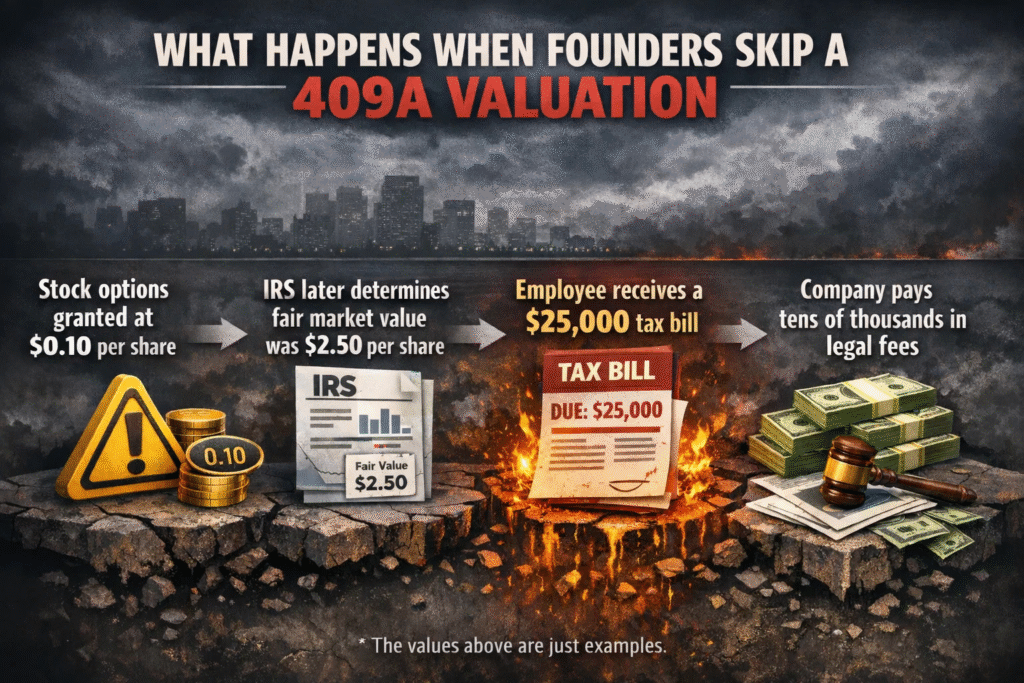
Here’s what goes wrong when founders skip it. You give stock options at 10 cents per share. Two years pass. The IRS knocks on your door. They say the real value was $2.50 per share. Your employee gets a $25,000 tax bill. Your company pays tens of thousands in legal fees.
This happens all the time. Startups guess their stock price instead of getting proper valuations. The IRS doesn’t allow guessing. One mistake can sink your company.
This guide answers the basic questions about 409A valuations. What is it? Why does it have that name? Who needs one? When do you get it? How much does it cost?
What Is a 409A Valuation?
A 409A valuation tells you what your company’s common stock is worth. An outside expert calculates this number for you. You need it before giving stock options to anyone on your team.
The number sets the price employees pay for their options. This price is called the strike price or exercise price. It protects you from IRS penalties that can destroy your startup.
The valuation lasts for 12 months. After that, you need a new one. Federal law requires every private company to get this done. Public companies don’t need it because their stock trades openly on exchanges.
Why It’s Called a 409A Valuation
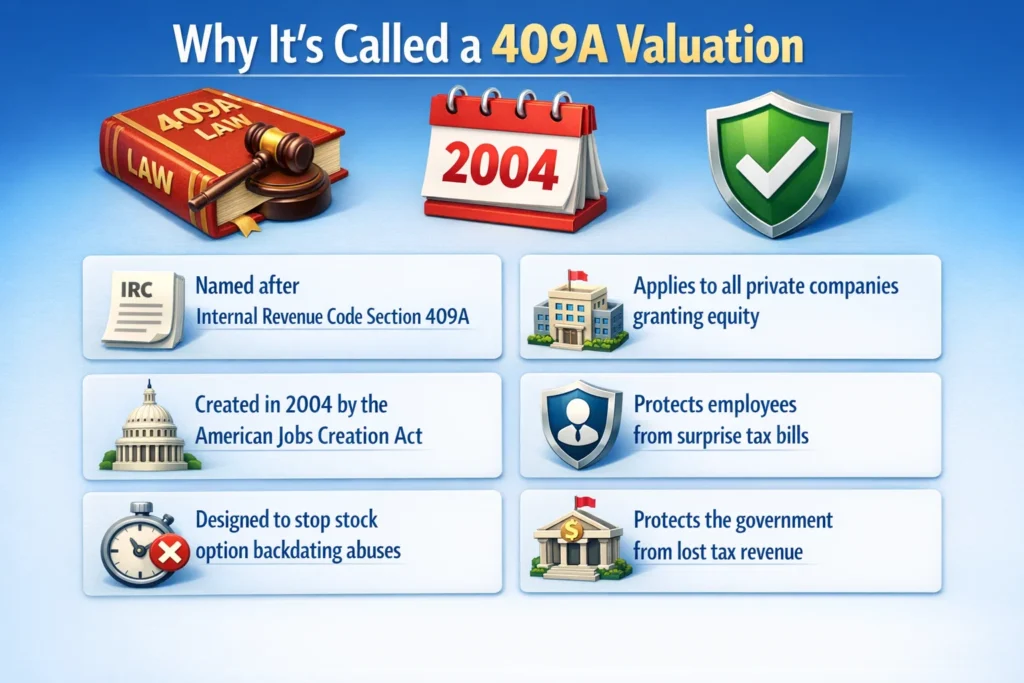
The name comes from Internal Revenue Code Section 409A. Congress created this rule in 2004 through the American Jobs Creation Act. Big companies were backdating stock options to help executives avoid taxes.
The new law stopped these tricks. Now every private company must follow Section 409A rules. The rule protects employees from surprise tax bills. It also protects the government from losing tax revenue.
Understanding Fair Market Value
Fair market value means what a willing buyer would pay a willing seller. Both sides know all the facts about the company. Nobody gets forced into the deal.
For private companies, no public market exists to reveal this price. Experts must calculate it using financial analysis and market data. Appraisers look at similar companies in your industry. They check what investors paid for comparable startups.
Common stock is always valued lower than what investors pay. Investors buy preferred stock with special rights. Preferred stock gets paid first if the company sells. Common stock has none of these protections, so it costs less.
Why Your Startup Needs a 409A Valuation
Federal law requires a 409A valuation before you give stock options. This protects employees from getting taxed on compensation they can’t actually spend yet. It protects your company from IRS penalties that can reach up to 40% when combined with regular income taxes.
Here’s what you avoid with a proper 409A valuation:
- Employee income tax on the spread between the strike price and the real value
- 20% federal penalty on top of regular income tax rates per IRC Section 409A
- State penalties that stack on federal penalties
- Loss of your company’s tax deduction for employee pay
- Securities law violations and additional legal exposure
- Legal fees that can reach tens of thousands of dollars
- Company liability for employee tax obligations in some cases
Real example: An engineer exercises 10,000 options at 50 cents per share. The IRS later says the fair market value was actually five dollars per share. The taxable income becomes $45,000. At a 35% tax rate plus the 20% penalty, the employee owes nearly $25,000 in taxes and penalties.
How the IRS discovers problems:
- Company acquisitions trigger automatic scrutiny
- Whistleblowers report issues for reward money
- Regular audits examine equity compensation
- Large option grants flag automated systems
- Secondary stock sales reveal different market prices
- Investors report compliance issues during due diligence
- Former employees file complaints with regulators
- IPO preparation uncovers old valuation mistakes
Many startups discover compliance issues during acquisitions, funding rounds, or when preparing for IPOs.
When You Need a 409A Valuation
1. Before You Give Your First Stock Options
You can’t legally give options without a current 409A valuation. Get this done during incorporation or within 30 days. Plan three to four weeks before your first hire receives options. Most founders wait until the last minute, creating unnecessary pressure.
2. Every 12 Months Without Exception
IRS safe harbor protection expires exactly one year after your valuation date. This happens even if nothing changed. Set a calendar reminder for 11 months after each valuation. Missing this deadline by one day exposes you to penalties.
3. Within 30 Days After Raising Money
New investors establish a preferred stock price that changes your value. You must get a new valuation within 30 days of closing per IRS guidance. Common stock prices typically increase by 30 to 50% of whatever the preferred stock increased.
4. After Major Business Changes
Material changes include large customer wins or losses, product launches that shift your business model, and executive departures. Business pivots to new markets trigger requirements. When unsure, ask your valuation provider.
5. Before Selling Your Company
Buyers require valuations less than 90 days old at closing. Plan to update as soon as acquisition discussions become serious. Current valuations help close transactions faster.
What a 409A Valuation Costs
Early-stage startups pay $2,000 to $5,000 for their first valuation. Series A companies pay $5,000 to $10,000. Later-stage businesses pay $15,000 to $20,000 or more. Software tools cost $500 to $1,500 but carry a higher audit risk.
The process takes two to four weeks. You provide documents in week one. The appraiser analyzes data in week two. Draft reports arrive in week three. Final reports come by week four.
Annual renewals cost 50 to 70% of your initial fee. Expedited processing adds $1,000 to $5,000 for one week turnaround.
Traditional Firms vs Software Tools
| Provider Type | Cost Range | Timeline | IRS Trust Level | Best For |
| Traditional Firms | $3,000 to $20,000 | 3 to 4 weeks | Highest | Series A and up |
| Software Tools | $500 to $1,500 | 1 to 2 weeks | Generally good | Very early stage |
| Hybrid Services | $1,500 to $5,000 | 2 to 3 weeks | High | All stages |
Traditional firms hire credentialed experts with ASA or CFA designations. ASA stands for Accredited Senior Appraiser from the American Society of Appraisers. CFA means Chartered Financial Analyst. They produce detailed reports that stand up to IRS scrutiny.
Software platforms automate the process using algorithms. Hybrid models combine automation with human expert review.
Pre-seed companies with simple ownership can use software. Series A and beyond should invest in traditional firms.
Hidden Costs That Surprise Founders
- Annual renewals every 12 months ($1,500 to $7,000)
- Expedited processing for rush jobs ($1,000 to $5,000)
- Cap table cleanup if records contain errors ($500 to $2,000)
- Additional reports for specific investors ($500 to $2,000)
- Updates after funding rounds (match initial costs)
- Supplemental analysis for secondary sales
How the Process Works
Documents your appraiser needs:
- Complete cap table showing all equity holders
- Financial statements from the past two years
- Business plan explaining your business model
- Recent funding term sheets and agreements
- Revenue projections for three to five years
- Customer pipeline and major contracts
- Organizational chart and key employee info
- Previous 409A reports if any exist
What you get in the final report:
- 30 to 60 pages of analysis and documentation
- Executive summary in plain language
- Comparable company analysis with market data
- Financial analysis showing calculations
- Clear statement of fair market value per share
- Valid for 12 months or until a material event occurs
- Share the strike price with employees, keep the full report confidential
Three accepted methods exist per IRS and ASA standards: the market approach, the income approach, and the asset approach. Most startups get market approach valuations because comparable company data exists.
Mistakes That Create Legal Problems
1. Using Old Valuations Past 12 Months
Safe harbor protection disappears after 12 months per IRS regulations. The IRS can challenge any grants during gap periods. Set automatic reminders for renewals.
2. Hiring Friends or Your Own Staff
Your accountant can’t provide your 409A valuation. The IRS requires complete independence. Find independent experts with proper credentials, like ASA or CFA designations.
3. Hiding Bad News from Your Expert
Term sheets, revenue problems, and lost customers all affect valuation. Incomplete data leads to conservative valuations. Full transparency produces accurate results.
4. Mixing Up Your 409A with Investor Prices
Preferred stock costs more than common stock. Your 409A typically comes in at 20 to 40% of post-money valuation. Never promise option values based on investor prices.
5. Skipping Updates After Big Changes
Material events include major contracts, key hires, and pivots. Updating late creates worse problems than updating early. Ask your provider when unsure.
Your Action Plan
Steps to stay compliant:
- Get initial valuation before making first option offers
- Update within 30 days after closing funding rounds
- Compare two to three providers with relevant experience
- Check credentials like ASA or CFA, and ask about track records
- Request sample reports to evaluate quality
- Gather all documents before starting
- Allow three to four weeks before granting options
- Set a reminder for renewal in 11 months
- File report with corporate records
- Use the strike price for all option grants
Frequently Asked Questions
What exactly is a 409A valuation?
A 409A valuation is an outside expert’s calculation of what your company’s stock is worth. The IRS requires this before you can give stock options to employees. An independent expert looks at your finances and those of similar companies to figure out your stock price.
How much does a 409A valuation cost?
Early startups pay $2,000 to $5,000 for their first valuation. Series A companies pay $5,000 to $10,000. Later companies pay $15,000 to $20,000 or more. Yearly renewals cost 50 to 70% of the first price.
How often do I need to update it?
You must update every 12 months minimum per IRS safe harbor rules. You also need updates within 30 days after raising money or other material events. Most startups need two to three valuations in their first two years.
Can I do my own 409A valuation?
No. The IRS requires an independent expert to provide safe harbor protection. Your accountant or founder team can’t do it. Using someone unqualified exposes you to the same penalties as having no valuation.
What happens if I skip getting a 409A valuation?
Employees pay income tax plus a 20% IRS penalty per Section 409A. Your company loses its tax break. Legal fees can reach tens of thousands of dollars. The IRS can challenge your prices years later and charge penalties retroactively.
Get Expert Help with Your 409A Valuation
Understanding 409A valuations shouldn’t slow your growth plans. Whether you’re preparing for first option grants or managing compliance after funding rounds, the right help makes everything easier.
Bookman Capital works with startups on financial requirements and regulatory compliance. Our team has helped hundreds of companies through funding rounds, option programs, and valuation questions.
Don’t let compliance questions delay your hiring or create unnecessary risk. Contact Bookman Capital today to connect with advisors who understand startup finances.
Sources:
Guidance Under § 409A of the Internal Revenue Code
ASA Business Valuation Standards (BVS-I through BVS-XII)
National Venture Capital Association (NVCA) – Model Legal Documents and Compliance Guidance