

The global startup economy has changed everything about equity compensation. Startup equity just got complicated. Really complicated.
Your engineering team sits in Berlin. Your sales reps work from Manila. Investors wire funds from Singapore. You’re building something global, but your stock option paperwork? Still stuck in 2015.
409A valuations are no longer just another compliance checkbox for American startups. They’ve become the financial passport your company needs to operate across borders. Miss this, and you’re not just risking IRS penalties. You’re potentially creating tax nightmares for employees on three continents.
Why 409A Valuations Went Global (And Why That Matters to You)
Startups don’t respect borders anymore. We’ve seen this shift accelerate since 2020.
A Boston-based SaaS company hires developers in Poland and customer success managers in Mexico. They raised a Series A from a London-based VC firm. Every employee getting options needs compliant documentation. The 409A valuation becomes the common language.
Your Singaporean investor needs to understand how you price equity for your Austin headquarters team. Your remote developers in Lisbon deserve the same clarity on their compensation as your San Francisco engineers. The valuation bridges these gaps.
Honestly, remote work broke the old model. Companies can’t treat equity compensation as a purely domestic concern anymore. Remote work has transformed startup operations, with many venture-backed companies now managing distributed teams across multiple countries.

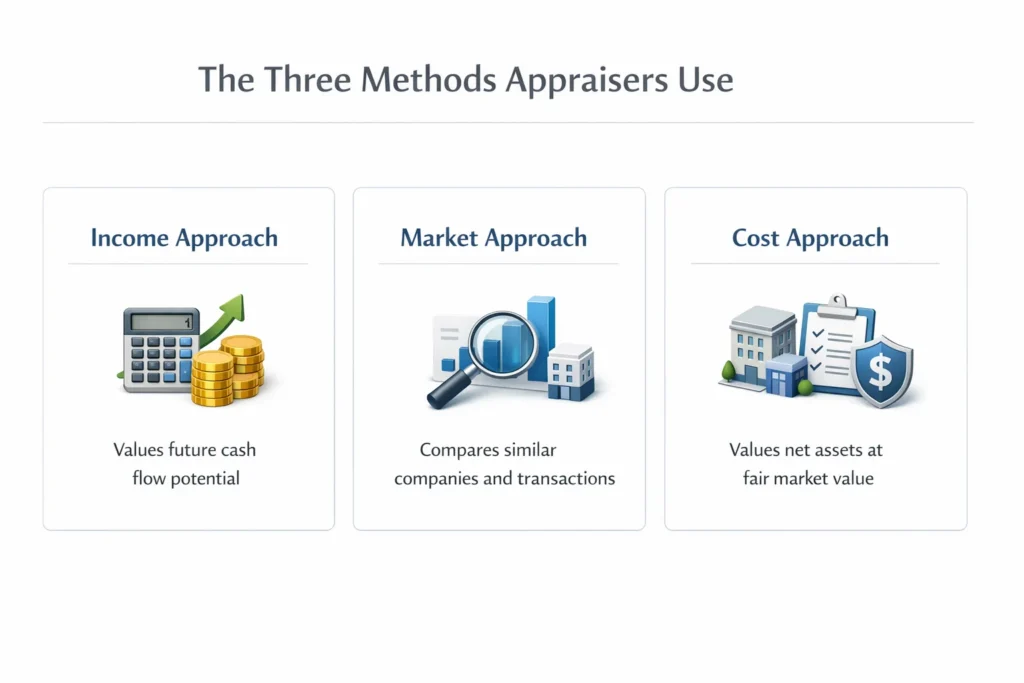
The Three Methods Appraisers Actually Use
No magic formula exists for valuing private companies. Appraisers combine established methods with judgment calls. They weigh economic conditions, market data, and company-specific risk factors.
Income Approach: Betting on the Future
This method values companies based on future cash flow potential. Appraisers project earnings multiple years out. Then they discount those future earnings back to present value.
The discount rate accounts for investment risk. Higher risk means higher discount rates. Lower present value follows.
This works best for companies with predictable revenue streams. Subscription businesses often get valued this way. Early-stage startups with no revenue? Not so much.
Market Approach: Learning from Similar Deals
This approach compares your company to others. Think of it as benchmarking, but for valuation.
Three common techniques:
- Guideline Public Company Method: Compares your startup to similar public companies. Valuation multiples from public markets get adjusted for liquidity differences and applied to your metrics.
- Guideline Transaction Method: Looks at recent M&A deals in your industry. Real acquisition prices inform valuation multiples.
- Backsolve Method: Takes your most recent preferred stock financing round and works backward. An option pricing model calculates what the common stock must be worth. This dominates in venture-backed startups.
The backsolve method deserves special attention. When you raise a Series A at $10 per preferred share, that’s not the common stock value. Preferred shares carry liquidation preferences, anti-dilution rights, and other protections. Appraisers use sophisticated models to determine the common stock value, which almost always comes in significantly lower.
Cost Approach: Adding Up the Pieces
This method values companies based on net asset value. Book values get restated to fair market value. You’re basically asking: what would it cost to rebuild this company from scratch?
This fits holding companies or asset-heavy businesses. Startups with most value in brand, team, and technology? Poor fit. Your $2 million in servers and office furniture doesn’t capture a $50 million valuation.
When You Actually Need a New 409A Valuation
The safe harbor rule says get one every 12 months. That’s the minimum.
Material events trigger the need for fresh valuations. The global economy creates more of these events than ever.
Events That Demand Immediate Revaluation:
| Trigger Event | Why It Changes Everything |
| New funding round closes | Capital structure shifts. Risk profile changes. Preferred stock pricing creates new common stock implications. |
| Major partnership launches | Strategic deals alter revenue trajectory. Market positioning shifts overnight. |
| New market expansion begins | Operating in additional countries changes total addressable market. Compliance requirements multiply. |
| Significant IP gets granted | A key patent approval can jump asset value substantially. Trade secret protection matters too. |
| Financial metrics swing hard | Missing targets by 40% changes the story. Beating them by 60% does too. |
Beyond these clear triggers, softer events matter. Maybe your competitor just got acquired at 20x revenue. Or maybe three competitors just shut down. Market dynamics shift constantly.
The goal? Maintain a defensible valuation history. When you face IRS scrutiny or buyer due diligence, your valuation timeline needs to make sense. Gaps and inconsistencies raise red flags.
Global Startup Economy Expansion Creates Valuation Chaos (Here’s Why)
Building teams across borders introduces challenges that traditional 409A models weren’t built to handle. We’ve watched this play out hundreds of times.
Compliance Becomes a Maze
Different countries tax stock options differently. France treats them one way. Singapore another. The UK has its own rules.
Your 409A must support compensation strategies across jurisdictions. Get this wrong and your Berlin engineer faces an unexpected tax bill. That’s not theoretical. It happens.
Currency Risk Compounds Everything
You bill customers in euros. Pay contractors in Brazilian reals. Raise money in US dollars. Exchange rates fluctuate daily.
Appraisers need to account for foreign exchange exposure. A company with 70% European revenue faces different risks than a purely domestic one. The discount rate should reflect this. Many older valuation models don’t.
Finding Real Comparables Gets Tricky
Comparing your global fintech startup to only San Francisco fintechs misses the point. You compete with companies in London, Singapore, and Tel Aviv.
Appraisers need cross-border market knowledge. They need access to international transaction data. Not every valuation firm has this. Most don’t, honestly.
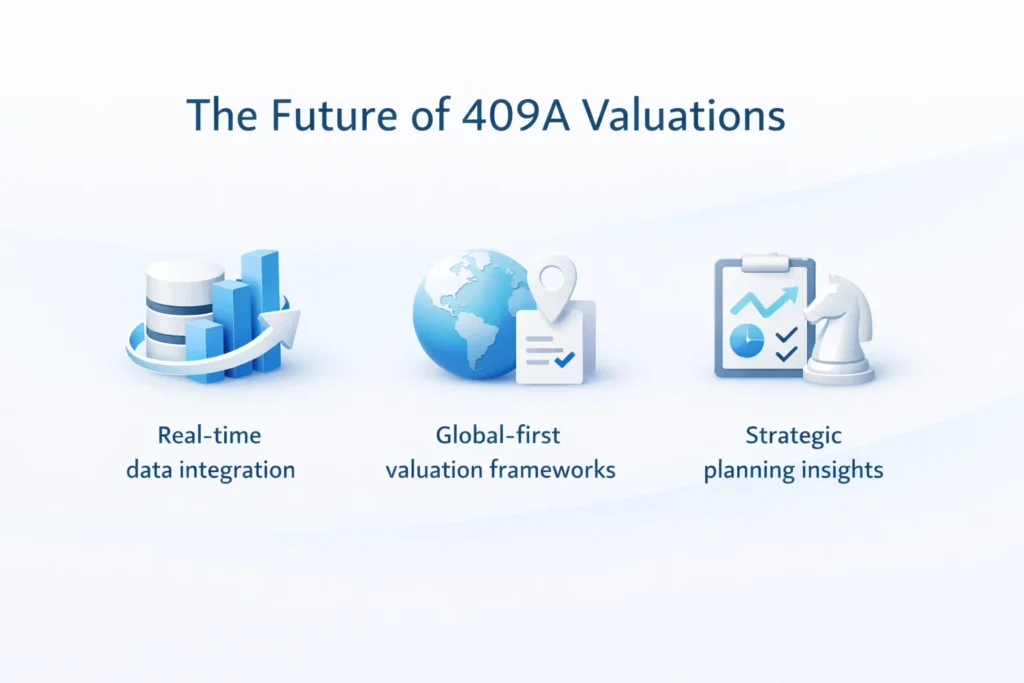
The Next Wave: Where 409A Valuations Are Headed
The future makes 409A valuations more dynamic and more strategic. They stop being backward-looking compliance documents. They become forward-looking management tools.
Real-Time Data Integration Arrives
Valuation models will connect directly to company systems. Monthly recurring revenue feeds in automatically. Customer churn rates update in real time.
This allows faster revaluations after material events. Instead of waiting two weeks for updated financials, appraisers pull current data instantly. Valuations get done in days, not weeks.
Global Frameworks Become Standard
Valuation providers are building models that assume multi-country operations from day one. Reports will break down revenue by geography. Risk analysis will include country-specific factors.
Investors want this clarity. Boards need it. The old single-country model doesn’t serve global companies well. New frameworks will.
Strategic Planning Meets Valuation
Founders will stop viewing 409A reports as compliance overhead. The detailed analysis reveals business model strengths and weaknesses. Third-party validation of your growth story has value beyond option grants.
Smart companies already use their valuations in board discussions. They inform pricing strategies. They help with financial planning. This trend accelerates.
Picking Your 409A Partner (This Actually Matters)
The cheapest provider rarely delivers the best value. We think the right partner does more than produce a compliant report.
Look for industry-specific experience first. A firm that values B2B SaaS companies understands your metrics. One that specializes in biotech won’t.
Ask about international experience directly. Have they handled valuations for companies with substantial foreign operations? Can they speak to cross-border tax implications?
Methodology transparency matters. The firm should explain their approach in plain language. Red flag: they can’t articulate why they chose specific comparable companies.
The best partners act as advisors. They help you communicate the valuation to your team. They build a coherent narrative across multiple valuations. This creates trust with employees and future acquirers.
Common Questions About 409A Valuations
How long does getting a 409A valuation actually take?
Expect two to three weeks from kickoff to final report. This includes a management interview, financial modeling, and review cycles. Companies with organized financials and clear narratives move faster. Those scrambling to produce cap tables and financial statements take longer.
What information do we need to provide?
Both numbers and narrative matter. Financial statements for the past few years. Your cap table with all option grants. Business plan or financial projections. Details on recent funding rounds or material events. You’ll also discuss market dynamics, competitive position, and key risks. The qualitative context shapes the quantitative analysis.
What happens if we skip the 409A valuation entirely?
The IRS can reclassify your stock options as compensation income. Your employees face immediate tax bills on the option grant, not just on exercise. Penalties stack up fast. The company also faces penalties and reputational damage. Skipping the valuation to save a few thousand dollars can cost millions later.
Can we just use our last funding round price for common stock?
No. The preferred stock price from your Series A doesn’t equal the common stock fair market value. Preferred shares carry liquidation preferences, board seats, and anti-dilution protection. These rights have real value. The 409A valuation, often through the backsolve method, determines the legally defensible common stock price. This almost always comes in significantly lower than the preferred price.
Partner With Experts Who Speak Your Growth Language
Operating across borders requires knowing your company’s real value at any moment. At Bookman Capital, we deliver more than compliance documents. We provide the analysis and strategic insights global companies need to operate confidently.
Our experts build valuation narratives that support growth, satisfy compliance across jurisdictions, and prepare you for what comes next.
Ready to get clarity on your valuation? Contact Bookman Capital at https://bookmancapital.io/contact/ for a comprehensive 409A valuation built for the global economy.
Sources: