

Every dollar you spend acquiring customers either builds wealth or burns it. The difference? Understanding Customer Lifetime Value (LTV).
Most founders obsess over getting new customers through the door. They track acquisition costs down to the penny. Yet they overlook the metric that reveals whether those customers are actually profitable. A customer who spends $50 once and disappears forever destroys value. A customer who returns monthly for three years and generates $3,600 creates it.
So what exactly is this metric that separates profitable growth from expensive failure?
What Is Customer Lifetime Value and Why Does It Matter?
Customer Lifetime Value (LTV) represents the total net profit your business expects to earn from a single customer throughout your entire relationship. Think of it as the big picture view of what each customer is really worth to you.
The concept emerged from Robert Shaw and Merlin Stone’s 1988 book Database Marketing: Strategy and Implementation. They recognized something revolutionary: not all customers contribute equally to business profitability. This insight shifted the entire marketing world from counting transactions to valuing relationships.
The calculation combines three elements: how much customers spend per transaction, how frequently they make purchases, and how long they stick around. Arthur Hughes expanded on this by creating the RFM model (Recency, Frequency, Monetary) in 1994, which became the foundation we still use today.
Then Frederick Reichheld of Bain & Company proved just how powerful this concept was. His research showed that increasing customer retention rates by just 5% boosted profits between 25% and 95%.
Today, Customer Lifetime Value determines how much businesses are worth when they sell. According to Flippa, companies that can show high CLV with strong retention metrics get premium offers during acquisitions. SaaS businesses that achieve a 3:1 LTV to CAC ratio typically sell for 2.5x to 4.5x their profit.
Revenue growth looks great on paper. But what good is growth if customers leave faster than you can replace them? LTV shifts your focus from chasing transactions to building relationships.

Why Sophisticated Buyers Care About This Number
Private equity firms and strategic acquirers look at Customer Lifetime Value before almost anything else. They want two things: predictable cash flows and sustainable unit economics. A business with high LTV compared to acquisition costs delivers both.
Strong Customer Lifetime Value metrics give buyers confidence. They can forecast revenue accurately. They understand exactly how much they can invest in growth while staying profitable. That certainty is worth paying extra for.
The Hidden Costs of Ignoring LTV
Running your business without tracking Customer Lifetime Value creates three expensive problems.
First, you overspend on acquisition channels that bring in low-value customers. Your marketing budget chases vanity metrics like clicks and impressions instead of profitable growth.
Second, you miss opportunities to nurture high-value segments. Without LTV segmentation, you treat a customer who will spend $10,000 exactly the same as one who will pay $100.
Third, you make blind decisions about pricing, product development, and expansion. These choices require understanding how changes affect long-term customer value.
Understanding the Complete Customer Lifetime Value Definition
Customer Lifetime Value (LTV) represents the total net profit you expect from a customer during your entire relationship. Some industries call this CLV or CLTV. Don’t get confused by the acronyms. They all measure the same thing.
Breaking Down the Three Core Components
Average Revenue Per User (ARPU) measures how much customers spend in each time period. For subscription businesses, you divide monthly recurring revenue by active subscribers. For transaction-based models, multiply the average purchase value by the purchase frequency.
Customer lifespan tracks the relationship from first purchase to last. SaaS companies measure this in months or years of active subscriptions. E-commerce businesses track the time between first and final orders.
Churn rate reveals the percentage of customers who stop buying during each period. A 5% monthly churn rate means you lose 5 out of every 100 customers each month. Lower churn directly increases Customer Lifetime Value.
Historical LTV vs Predictive LTV Models
Historical Customer Lifetime Value looks backward. It calculates actual spending from existing customers to date. This method works great for understanding current customer value but tells you nothing about future business performance.
Predictive LTV looks forward. It uses historical data, behavioral patterns, and machine learning to forecast future customer value. This approach helps with strategic planning, budget allocation, and growth projections.
Most early-stage companies start with historical LTV because they have limited data. As customer cohorts mature, they transition to predictive models.
The Essential Formulas for Calculating Customer Lifetime Value
You don’t need a PhD in mathematics to calculate LTV. Three formulas cover most business scenarios.
The Basic Formula Every Business Can Use
The simplest Customer Lifetime Value calculation multiplies three numbers:
LTV = Average Purchase Value × Purchase Frequency × Customer Lifespan
Let’s use a real example. Consider a specialty coffee shop. Customers spend an average of $15 per visit. The typical customer visits twice monthly, which equals 24 times yearly. Loyal customers continue this pattern for three years on average.
The calculation: $15 × 72 visits (24 per year × 3 years) = $1,080 LTV.
The SaaS Standard Formula
Software businesses need a different approach because of how subscriptions work:
LTV = (ARPU × Gross Margin) ÷ Churn Rate
Here’s a practical example. Take a B2B SaaS company with $120 monthly ARPU, 80% gross margin, and 5% monthly churn rate.
The calculation: ($120 × 0.80) ÷ 0.05 = $1,920 LTV.
Why include gross margin? Because Customer Lifetime Value should reflect profit, not just revenue. A business with 80% margins keeps $0.80 from every revenue dollar.
Real Examples Across Business Models
E-commerce furniture retailer: Customers spend $800 per order on average. They purchase every 18 months. The average customer relationship lasts 6 years. LTV = $800 × 4 purchases = $3,200.
Marketing agency: Clients pay $5,000 monthly. Average gross margin is 60%. The monthly churn rate is 3%. LTV = ($5,000 × 0.60) ÷ 0.03 = $100,000.
Notice the scale differences between industries. Both approaches work when you understand your LTV.
The LTV to CAC Ratio Determines Sustainable Growth
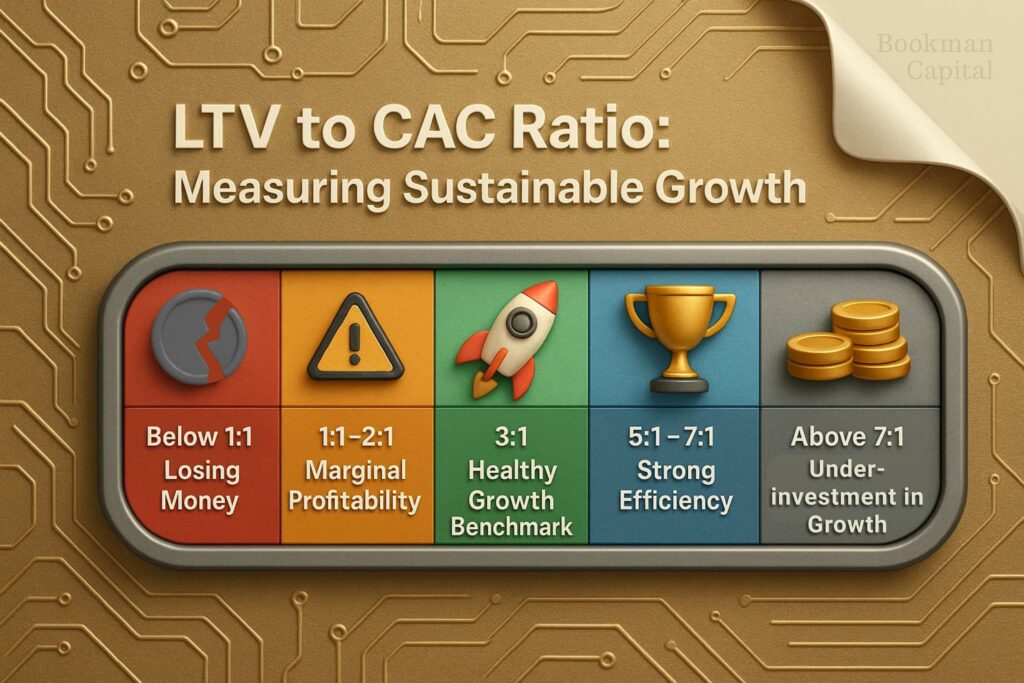
Customer Lifetime Value alone doesn’t tell you enough. You need to compare it to Customer Acquisition Cost (CAC) to understand true profitability. A ratio of 3:1 means every dollar spent on acquisition returns three dollars in lifetime value.
Calculate CAC by dividing total acquisition spending by new customers acquired. Include everything: marketing costs, sales salaries, advertising spend, and related overhead.
Industry Benchmarks That Actually Matter
Different business models support different ratio standards. B2B SaaS companies target 4:1 ratios because of their higher gross margins and lower churn. E-commerce businesses operate profitably at 2:1 to 3:1 ratios because of thinner margins.
First Page Sage research reveals something interesting: 68% of LTV to CAC data comes from organic marketing channels. Organic channels consistently achieve higher ratios than paid advertising.
What Your Ratio Really Tells You
Below 1:1 signals a crisis. You’re losing money on every single customer.
Between 1:1 and 2:1 indicates marginal profitability. This range requires serious optimization before you scale.
At 3:1, you’ve achieved the standard benchmark. This ratio supports sustainable growth with healthy unit economics.
Between 5:1 and 7:1 demonstrates strong efficiency. Consider whether you should increase marketing investment to accelerate growth.
Above 7:1 suggests underinvestment in growth. You might be leaving money on the table.
Proven Strategies That Increase Customer Lifetime Value
Improving Customer Lifetime Value requires focusing on two levers: extending customer relationships and increasing spending per customer.
Five Retention Strategies That Work
1. Master the First 90 Days
The initial three months determine long-term retention. Create structured onboarding sequences with clear milestones. Send welcome emails with specific next steps. Provide video tutorials addressing common questions before customers ask them.
2. Design Loyalty Programs That Actually Retain
Starbucks Rewards demonstrates effective loyalty program design. Reward program members represent over 40% of U.S. sales and visit significantly more frequently than non-members. The program works because rewards are clear, easy to earn, and genuinely valuable.
Implement point systems with transparent earning rules. Offer exclusive perks unavailable to non-members. Create tiered structures that reward increased spending.
3. Deliver Support That Exceeds Expectations
Fast support responses correlate directly with higher renewal rates. Customers who receive same-day support show 30% higher retention than those waiting multiple days.
Personalize support using customer history. Answer questions before they’re asked through proactive outreach. Empower support teams to solve problems without escalation.
4. Transition to Subscription Models
Subscriptions create predictable revenue while increasing Customer Lifetime Value. They reduce friction for repeat purchases and establish buying habits. Amazon Prime demonstrates this perfectly: members spend significantly more than non-members.
Offer flexible subscription options: monthly, annual, or usage-based. Allow pausing or skipping rather than forcing cancellation.
5. Leverage Behavioral Segmentation
Segment your base by purchase frequency, average order value, and product preferences. Send targeted communications based on actual behavior, not assumptions. Identify at-risk customers early using engagement metrics.
Four Revenue Expansion Tactics
1. Perfect Cross-Selling and Upselling
Amazon generates 35% of revenue through “frequently bought together” recommendations based on actual purchase patterns.
Recommend complementary products naturally after purchases. Suggest upgrades when customers hit usage limits. Time offers strategically around renewal periods or after positive experiences.
2. Build Premium Tiers That Customers Want
Premium offerings increase Customer Lifetime Value without acquiring new customers. Add advanced features genuinely useful to power users. Provide priority support with faster response times.
3. Turn Customers Into Acquisition Channels
Reward both referrer and new customer. Make sharing easy with pre-written messages and one-click sharing. Focus referral asks on highly satisfied customers for the best conversion rates.
4. Optimize Pricing Based on Value Delivered
Willingness to pay increases as customers extract more value. Send upgrade prompts when usage approaches tier limits. Offer grandfathered pricing for long-term customers upgrading. Always communicate pricing changes transparently.
Frequently Asked Questions
What differentiates LTV from CLV?
Customer Lifetime Value (LTV) and Customer Lifetime Value (CLV) represent identical metrics. Both measure total expected profit from a customer relationship. Don’t worry about the terminology. Focus on understanding the concept.
How should new businesses approach LTV calculation?
New businesses start with the basic formula using industry benchmarks for initial projections. After collecting 3 to 6 months of actual customer data, transition to company-specific calculations. Early estimates won’t be perfect, but they’re directionally useful for planning.
What defines a good Customer Lifetime Value?
“Good” LTV depends entirely on your Customer Acquisition Cost. The critical metric is your LTV to CAC ratio. Target at least 3:1 for most business models. SaaS companies should aim for 4:1 or higher. E-commerce businesses operate successfully at 2:1 to 3:1.
Can you increase LTV without raising prices?
Absolutely. Customer Lifetime Value increases through better retention and higher purchase frequency. Implement loyalty programs, improve onboarding, offer subscriptions, cross-sell complementary products, and deliver exceptional support. All these approaches improve LTV while maintaining pricing.
How often should businesses calculate Customer Lifetime Value?
Calculate Customer Lifetime Value monthly for active monitoring and quarterly for strategic decisions. Monthly tracking identifies trends early. Quarterly reviews enable deeper analysis and inform major business decisions. Always segment LTV by customer cohort and acquisition channel.
Your LTV Numbers Tell a Story: Are You Telling It Right?
Understanding Customer Lifetime Value is just the beginning. The real question is: are you positioning these metrics to maximize your business valuation?
At Bookman Capital, we help entrepreneurs unlock hidden value by identifying which LTV improvements deliver the highest valuation multiples. Not all optimizations move the needle equally. Some drive significant valuation increases. Others waste time on metrics buyers ignore.
Whether you’re scaling for the long haul or positioning for an exit, we’ll show you exactly where your business stands against buyer expectations and what specific changes will command premium offers.
Sources:
Harvard Business Review – “The Value of Keeping the Right Customers”
Bain & Company – “Prescription for Cutting Costs: Loyal Relationships”
First Page Sage – “The LTV to CAC Ratio Benchmark”