

You’ve probably seen the headlines: SaaS companies selling for eye-watering multiples. A business with $10 million in revenue commanding a $70 million valuation. It sounds excessive, right?
Why are SaaS valuations so high? Here’s the thing: these numbers aren’t random. They’re based on a business model that investors have learned to trust and, in many cases, absolutely love.
Let me walk you through exactly why SaaS companies command such high valuations, what’s changed in 2025, and what it takes to actually earn those premium prices.
What Makes SaaS Different From Traditional Businesses?
The short answer? Predictability and leverage.
When you buy traditional software, you pay once. The vendor gets a spike in revenue, then has to start from zero with the next customer. SaaS flips this model completely. Instead of one-time sales, you’re building a revenue engine that compounds over time.
The subscription model creates financial predictability. Monthly or annual subscriptions mean you can forecast revenue with confidence. If you have 1,000 customers paying $100/month, you’re starting next month with roughly $100,000 already locked in.
Profit margins that traditional businesses can only dream about. Once your software is built, serving customer 1,001 costs almost nothing. Most SaaS companies operate with gross margins above 80%. For every new dollar of revenue, 80 cents or more drops straight to your bottom line.
You can scale without breaking the bank. Thanks to cloud infrastructure, growing from 100 to 10,000 customers doesn’t require a proportional increase in costs. You’re not building new factories or opening new stores.
The expansion effect keeps on giving. Unlike a one-time purchase, subscriptions create ongoing relationships. A customer who starts with your basic plan might upgrade to premium, add more users, or buy additional features. This creates what we call Net Revenue Retention (NRR). When that number exceeds 100%, your existing customers are becoming more valuable every year.
Key Differentiators:
- Predictability and Leverage
- Recurring Revenue Model
- Financial Forecasting Confidence
- Exceptional Profit Margins
- Near-Zero Marginal Costs
- Cost-Efficient Scaling
- Built-In Expansion Revenue
- Net Revenue Retention (NRR) Growth
How Much Are SaaS Companies Worth in 2025?
Let’s get specific with numbers.
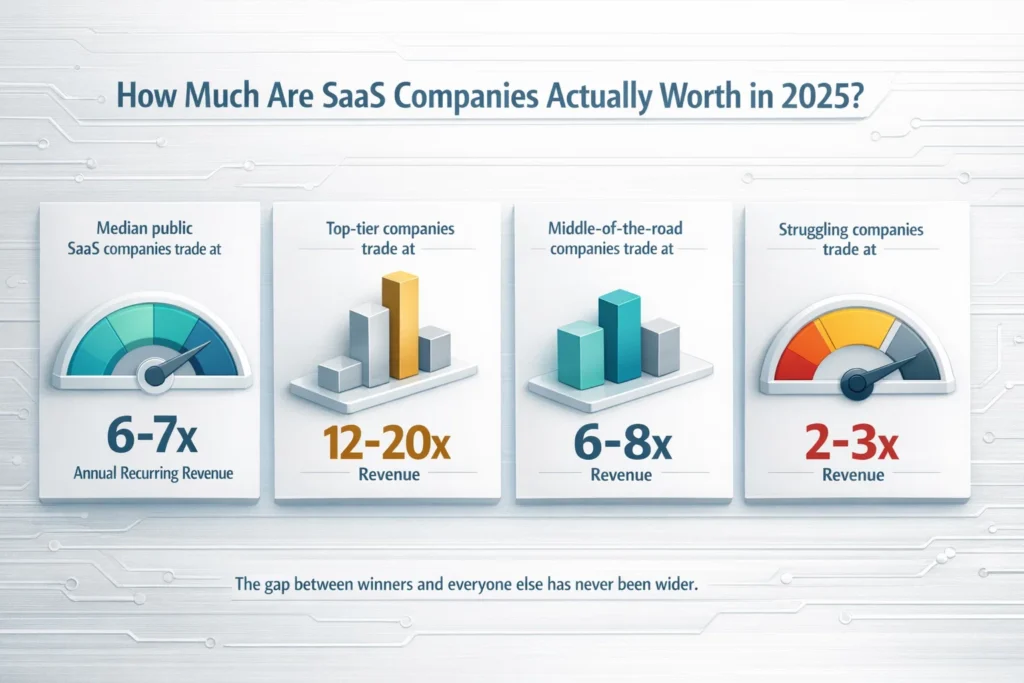
The median public SaaS company today trades at roughly 6-7x its annual recurring revenue. That’s come down from the wild peaks of 2021, when some companies were valued at 20-30x revenue.
But the average is misleading because top performers and struggling companies live in completely different worlds. Top-tier companies (growing 20%+ annually with strong retention) still command 12-20x revenue multiples. Middle-of-the-road businesses sit at 6-8x. Struggling companies with poor growth or retention might only fetch 2-3x, or sometimes less.
The gap between winners and everyone else has never been wider.
Why Do Some SaaS Companies Get Premium Valuations While Others Don’t?
Not all SaaS businesses are created equal. Here’s what separates the premium-priced companies from the rest.
Growth trajectory matters enormously. A company growing 40% year-over-year will command multiples 2-3x higher than one growing at 10%, all else being equal. Investors are buying future revenue, and faster growth means more future revenue.
Customer retention is everything. High churn destroys valuations. If you’re losing 5% of customers monthly, you’re on a treadmill where you have to run faster just to stay in place. Companies with monthly churn under 2% get rewarded handsomely.
Defensibility creates pricing power. Can customers easily switch to a competitor? Or have you built something deeply integrated into their workflows? Companies serving specific industries (what we call Vertical SaaS) often command premium valuations because they’re harder to replace.
Efficient growth beats expensive growth. Two companies, both growing 30%, might have wildly different valuations. The one spending $0.50 to generate $1 of revenue will be worth far more than the one spending $2 for that same dollar.
What Metrics Drive These Valuations?
If you’re building a SaaS business, these are the numbers that will determine your worth:
The Rule of 40 has become non-negotiable
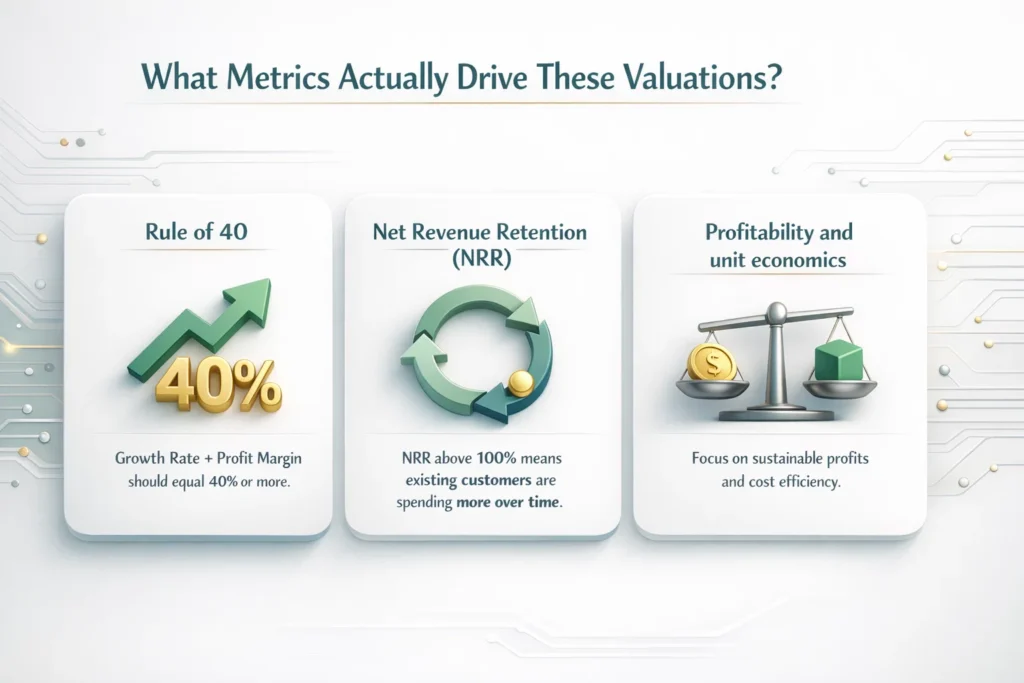
This simple formula has become the health check for SaaS businesses: Growth Rate + Profit Margin should equal 40% or more.
Growing at 30% with 10% profit margins? You hit it. Growing at 15% while maintaining 25% profitability? You’re there too. It proves you can grow fast while running a disciplined operation. The “growth at all costs” era is dead.
Net Revenue Retention is the king of metrics
If I could only look at one number to assess a SaaS company, this would be it.
NRR measures how much revenue you keep and expand from existing customers over time. A rate above 100% means your current customers are spending more this year than last, even accounting for churn. The best companies hit 120% or higher. Think about what that means: you could stop all new customer acquisition and still grow 20% annually.
Profitability has made a comeback
The days of burning cash to chase growth are over. Investors now demand clear unit economics. Specifically, they want to see that your customer lifetime value (LTV) is substantially higher than your customer acquisition cost (CAC). The most valuable companies today show a path to profitability, even if they’re not quite there yet.
What’s Driving Valuations Higher in 2025?
A few specific trends are pushing valuations up for the right companies.
The AI premium is real, but only when it’s credible. Simply slapping ‘AI-powered’ on your marketing won’t cut it. But if you can show how AI meaningfully improves your product or creates defensible advantages, investors will pay extra.
The key is demonstrating proven ROI from AI features, whether through reduced support costs, higher ARPU, or improved retention, rather than superficial integrations.
Enterprise customers are the golden ticket. Companies selling to large enterprises typically see higher valuations. Why? Larger contract sizes, lower churn rates, and more predictable revenue. The trade-off is longer sales cycles, but investors value the stability.
Product-led growth has proven itself. Companies where users can sign up and get value without talking to a salesperson tend to grow more efficiently. This self-service model has shown it can scale profitably.
How Can You Increase Your Company’s Valuation?
If you’re building a SaaS business, here are the concrete moves that will improve your valuation multiple:
Make retention your obsession. Every percentage point improvement in retention compounds dramatically over time. Invest in customer success teams, build features that increase stickiness, and monitor churn religiously. Moving NRR from 100% to 115% can literally double your valuation.
Optimize for the Rule of 40. Look at your current growth rate and profit margins.If you’re at 35%, you’re close but not there. You can trim some inefficient marketing spend to gain 5 points of margin. Companies scoring above 50% earn significant premium multiples, while those below 30% face serious valuation headwinds. Or try investing in a new distribution channel could add 5 points of growth.
Document your unit economics obsessively. Know your CAC, your LTV, your payback period, and your cohort retention by heart. When investors see you understand these numbers cold, they gain confidence. Better yet, show steady improvement in these metrics over time.
Build expansion revenue into your product. Don’t just focus on landing new customers. Create natural upgrade paths, add-on modules, or usage-based pricing that grows as customers grow. This is how you push NRR above 100%.
Consider specialization over generalization. A horizontal tool competing with hundreds of alternatives will struggle with valuation. A vertical solution that deeply understands and solves problems for a specific industry can command premium multiples due to reduced competition and higher switching costs.
Your Next Move: From Understanding to Action
High valuations aren’t about hype or hope. They’re earned through execution on specific, measurable metrics that prove your business model works.
In 2025, the market rewards companies that demonstrate predictable growth, strong customer retention, and efficient operations.
The companies commanding 15-20x revenue multiples aren’t lucky. They’ve built machines that predictably turn investment into recurring revenue, retain and expand that revenue over time, and do so with improving margins.
That’s the formula. Everything else is just details.
Want to understand exactly where your SaaS business stands and how to maximize its value? The team at Bookman Capital specializes in helping founders navigate valuation, growth strategy, and successful exits. For a confidential analysis of your company’s potential, visit bookmancapital.io today.
Sources: